

Key Takeaways
- Hotel benchmarking replaces guesswork with data-driven precision to outperform competitors.
- Although 73% of hotels collect performance data, less than 40% effectively use benchmarking strategies.
- Benchmarking hotels strategies are essential for converting data into measurable revenue and guest satisfaction improvements.
- Implementing a strategic benchmarking framework provides a competitive advantage for hospitality leaders.
Table of Contents
- What is Hotel Benchmarking? Defining the Practice and Its Critical Role in Hospitality
- Why Benchmarking is a Game-Changer for Hotels: Revenue, Guest Experience, and Efficiency
- How to Benchmark a Hotel: A Step-by-Step Playbook for Success
- Advanced Benchmarking Techniques and Tools for Hospitality Leaders
- Benchmarking in Action: Real-World Scenarios in Hospitality
Benchmarking Hotels for Competitive Advantage: A Strategic, Practical Framework for Hospitality Leaders
Hotel benchmarking transforms guesswork into precision, enabling properties to systematically outperform competitors through data-driven insights. While 73% of hotels collect performance data, fewer than 40% use benchmarking hotels strategies to convert that information into measurable revenue gains and guest satisfaction improvements. Hotel benchmarking solutions like Vynta AI can help properties leverage these strategies for maximum impact.
This comprehensive framework reveals how hospitality leaders leverage competitive intelligence to optimize everything from RevPAR to upselling performance, with real-world applications that deliver results within 90 days. Explore tailored benchmarking services for hotels to accelerate your revenue and guest satisfaction improvements.
What is Hotel Benchmarking? Defining the Practice and Its Critical Role in Hospitality
Core Definition and Purpose
Hotel benchmarking is the systematic process of measuring your property’s key performance indicators against a carefully selected competitive set or industry standards. Unlike generic business benchmarking, hospitality benchmarking focuses on metrics that directly impact guest experience and revenue generation, from average daily rates to upselling conversion rates.
The primary outcomes extend beyond simple performance comparison: effective benchmarking hotels practices enable precise revenue management, identify service optimization opportunities, and provide data-backed justification for operational investments that guests actually value.
Key Metrics in Hotel Benchmarking
| KPI | Definition | Why It Matters |
|---|---|---|
| RevPAR | Revenue per Available Room | Ultimate profitability measure combining occupancy and rate |
| ADR | Average Daily Rate | Pricing power indicator against competitive set |
| Occupancy Rate | Percentage of rooms occupied | Demand strength and market share measurement |
| GOPPAR | Gross Operating Profit per Available Room | True operational efficiency after costs |
| Guest Satisfaction Score | Aggregated review and survey ratings | Service quality benchmark for retention and pricing |
Most properties track these metrics daily for tactical decisions, weekly for trend analysis, and monthly for strategic planning. Annual benchmarking provides the foundation for budget planning and capital investment priorities.
Types and Levels of Hotel Benchmarking
Performance benchmarking compares your property against external competitors, providing market positioning insights. Process benchmarking examines internal operations across departments or multiple properties to identify best practices. Strategic benchmarking looks beyond hospitality to world-class service standards from any industry.
Competitive set selection is the foundation of effective hotel benchmarking. A 50-room urban boutique hotel should benchmark against similar properties within a 3-mile radius, not against 300-room resort destinations, regardless of star rating similarities.
Why Benchmarking is a Game-Changer for Hotels: Revenue, Guest Experience, and Efficiency
Benchmarking as a Driver of Measurable Outcomes
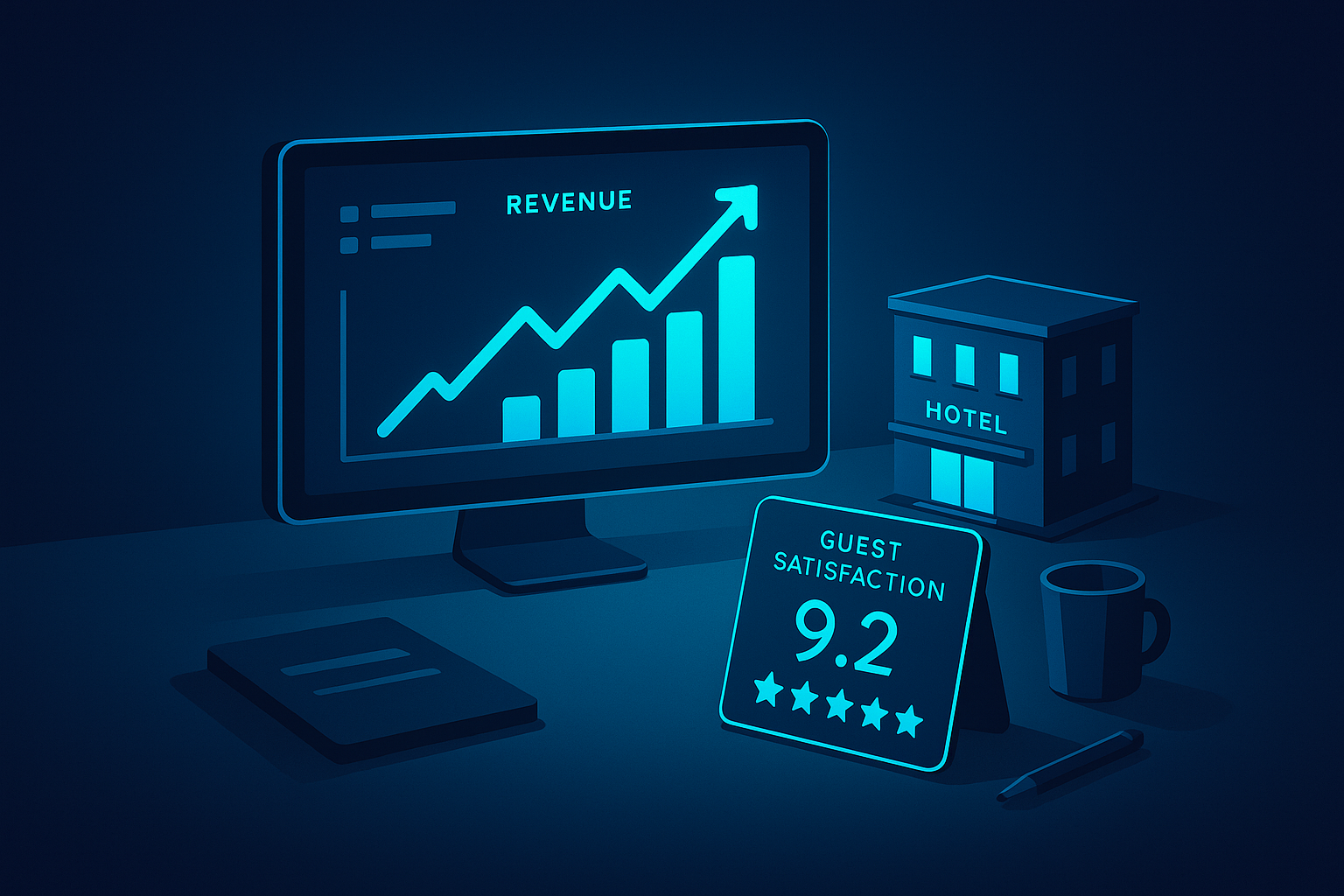
Properties using systematic benchmarking hotels approaches report average RevPAR increases of 12% within six months, primarily through optimized pricing strategies and targeted service improvements. Guest satisfaction scores improve by an average of 0.6 points when hotels benchmark and replicate competitor best practices.
Consider Maria, who manages a 60-room boutique property. After implementing monthly benchmarking against five local competitors, she identified that her weekend ADR lagged 18% below market. By adjusting her pricing strategy and introducing weekend packages based on competitor analysis, she closed that gap within three months while maintaining occupancy levels.
Common Benchmarking Use Cases in Hospitality
Revenue management benefits most immediately from benchmarking data, enabling dynamic pricing adjustments based on competitive positioning. Service optimization identifies which guest touchpoints drive satisfaction scores above market average. Resource allocation becomes data-driven when you understand which amenities and services competitors offer at similar price points.
| Use Case | Business Benefit | Typical Impact Timeline |
|---|---|---|
| Dynamic Pricing | 8-15% RevPAR increase | 30-60 days |
| Service Standards | 0.4-0.8 point satisfaction gain | 60-90 days |
| Upselling Programs | 12-25% ancillary revenue boost | 45-75 days |
| Dynamic pricing optimization | 15-25% RevPAR improvement | 30-45 days |
| Guest service standardization | 0.4-0.8 point satisfaction increase | 60-90 days |
| Upselling automation | 12-20% ancillary revenue growth | 45-60 days |
| Labor cost optimization | 8-12% operational cost reduction | 90-120 days |
Addressing Hospitality’s Unique Benchmarking Challenges
Seasonal demand fluctuations require rolling 12-month comparisons rather than month-to-month analysis. External events, from local festivals to economic disruptions, demand contextual data interpretation that generic benchmarking hotels tools often miss.
Successful properties handle data gaps by establishing minimum viable datasets: at least three comparable properties with 80% data completeness over six months. When outliers appear, such as a competitor’s renovation closure, experienced managers exclude those periods from trending analysis while maintaining them for strategic planning insights.
How to Benchmark a Hotel: A Step-by-Step Playbook for Success
Setting the Right Objectives and Scope
Define one primary KPI aligned with your immediate business goal before collecting any data. Properties focused on revenue growth should prioritize RevPAR analysis, while those addressing guest retention should emphasize satisfaction scores and repeat booking rates.
For example, if increasing revenue per guest is your objective, track both ADR progression and ancillary sales conversion rates, room service, spa bookings, and dining upsells, against your competitive set’s performance in these areas.
Selecting an Effective Competitive Set
Effective competitive sets include 3-7 properties matching your location radius (typically 3-5 miles urban, 15-25 miles resort), property size (within 50% of your room count), and target guest segment. Star ratings matter less than actual pricing and service positioning.
- Pitfall: Including aspirational competitors you’re not ready to match
- Pitfall: Selecting based on proximity alone without considering guest demographics
- Pitfall: Using static competitive sets that don’t evolve with market changes
| Poorly Chosen Compset | Optimized Compset | Result |
|---|---|---|
| Mixed property types and locations | Similar size, location, and guest profile | Actionable insights vs. misleading data |
| Aspirational luxury properties | Realistic competitive positioning | Achievable improvement targets |
Gathering and Validating Benchmarking Data
Internal data sources include your PMS for occupancy and rate data, POS systems for ancillary revenue tracking, and guest feedback platforms for satisfaction metrics. External sources provide competitive intelligence through industry platforms like STR Global, HotStats, or regional tourism boards. Learn more about key hotel industry terms and benchmarking standards to ensure your data is aligned with industry best practices.
Clean your data monthly by reconciling PMS reports with actual financial records. Discrepancies often reveal system errors or classification inconsistencies that skew benchmarking hotels analysis and lead to incorrect strategic decisions.
Analyzing Results and Closing Performance Gaps
Effective dashboard analysis identifies your three largest performance gaps first. If weekend occupancy lags 15% below your competitive set, investigate pricing strategy, package offerings, and marketing channels before addressing smaller variances in weekday performance.
Prioritize actions with immediate impact potential: rate adjustments can influence bookings within 48-72 hours, while service improvements require 30-90 days to reflect in satisfaction scores. Apply revenue management changes within three days of identifying gaps for optimal market response.
Implementing Changes and Monitoring Outcomes
Assign clear KPI ownership to specific team members, revenue managers own ADR and RevPAR, guest services manages satisfaction scores, and food & beverage directors track upselling metrics. This accountability structure ensures benchmarking hotels insights translate into consistent action.
Schedule monthly performance reviews with quarterly deep-dive analysis sessions. Monthly reviews address tactical adjustments, while quarterly sessions evaluate strategic positioning and competitive set relevance. Properties showing seasonal volatility benefit from weekly monitoring during peak periods.
Advanced Benchmarking Techniques and Tools for Hospitality Leaders
Benchmarking Platforms and Tools: Capabilities and How to Choose
Leading industry platforms serve different property profiles and analytical needs. STR Global excels in market-wide competitive intelligence, while HotStats focuses on profit-level benchmarking. Boutique hotels typically need basic RevPAR and ADR tracking, while multi-property chains require portfolio-wide analytics with drill-down capabilities.
| Platform | Best For | Core Metrics | Integration Support |
|---|---|---|---|
| STR Global | Market analysis & competitive intelligence | RevPAR, ADR, Occupancy | Major PMS systems |
| HotStats | Profit-focused benchmarking | GOPPAR, labor costs, departmental profit | Financial system APIs |
| Vynta AI | Automated guest experience optimization | Upselling, satisfaction, predictive analytics | Real-time PMS/CRM sync |
Platform integration requires API compatibility with your PMS for automated data flow. Properties using older systems benefit from batch import capabilities, while modern operations demand real-time synchronization for dynamic pricing decisions. Discover more about Vynta AI’s approach to hotel benchmarking and how it can integrate with your existing systems.
Using AI-Powered Benchmarking for Next-Level Insights
Vynta AI-driven analytics transform traditional benchmarking hotels approaches by predicting demand patterns, guest behavior shifts, and revenue optimization opportunities. The system identifies booking patterns that precede no-shows, enabling proactive overbooking strategies that maintain occupancy without guest displacement.
The human-AI workflow maximizes both technological capability and hospitality expertise: AI surfaces pattern recognition across thousands of data points, while experienced managers apply contextual knowledge and relationship insights to strategic decisions. This collaboration delivers measurable results without compromising the personal touch that defines exceptional hospitality.
Maria’s boutique hotel implemented Vynta’s automated reservation segmentation system, which analyzed guest booking behaviors and optimized midweek promotional targeting. Within three months, Tuesday-Thursday occupancy increased 15% while maintaining weekend premium pricing strategies. Research supports the use of AI and data analytics in hospitality benchmarking for improved operational outcomes.
Benchmarking Guest Experience and Upselling Performance
Guest journey metrics extend beyond traditional financial KPIs to include Net Promoter Score tracking, review sentiment analysis, and upsell conversion rates by touchpoint. Properties benchmark satisfaction scores against competitive sets while identifying specific service moments that drive revenue per guest improvements.
Shadow benchmarking through mystery guest programs provides qualitative insights that complement quantitative data. Booking competitor properties reveals service gaps and identifies best practices for adoption, particularly in areas like check-in efficiency, amenity presentation, and departure experience optimization.
- NPS Tracking: Quarterly guest satisfaction surveys benchmarked against local competitive set
- Review Management: Sentiment analysis comparing response times and resolution rates
- Upselling Metrics: Conversion rates by service category and guest segment
Best Practices for Benchmarking Across Multiple Locations
Multi-property groups standardize data collection while adapting competitive sets to local market conditions. Urban properties benchmark against business hotels, while resort locations compare with leisure-focused competitors. This localized approach maintains relevance while enabling portfolio-wide performance analysis.
Regional managers establish unified KPI definitions across properties while allowing location-specific competitive set selection. A downtown business hotel and beachfront resort within the same portfolio require different benchmarking frameworks despite shared operational standards and guest service expectations. Contact Vynta AI for a customized benchmarking strategy across your hotel portfolio and unlock actionable insights for every location.
Benchmarking in Action: Real-World Scenarios in Hospitality
Boutique Hotel Revenue Lift Through Integrated Benchmarking
Maria’s 50-room urban property identified a 10% weekday RevPAR gap through systematic competitive analysis against five comparable local hotels. The benchmarking revealed underperformance specifically in corporate traveler ADR, despite competitive occupancy rates during business travel periods.
Implementation of microsegmented rate plans targeting different business traveler profiles, consultant extended stays, pharmaceutical sales teams, and regional corporate accounts, closed the gap within eight weeks. The targeted approach increased weekday ADR by 12% while maintaining occupancy levels above competitive set averages. Read a detailed case study on benchmarking-driven revenue growth for more real-world examples.
Upselling Optimization in an Upscale Restaurant
Restaurant management discovered through benchmarking hotels analysis that beverage spend per cover lagged 18% below comparable properties despite similar food revenue performance. Guest feedback indicated satisfaction with wine selection but limited sommelier interaction during peak dining periods. Explore best practices for upselling optimization in hospitality to maximize ancillary revenue.
Frequently Asked Questions
What are the key performance indicators (KPIs) used in hotel benchmarking and why are they important?
Key KPIs in hotel benchmarking include RevPAR (Revenue per Available Room), average daily rate, occupancy rate, upselling conversion rates, and guest satisfaction scores. These metrics are crucial because they directly reflect a property’s financial performance and service quality, enabling hotels to identify gaps, optimize pricing, and enhance the guest experience for measurable revenue growth.
How does hotel benchmarking help improve revenue and guest satisfaction in the hospitality industry?
Hotel benchmarking provides data-driven insights that reveal performance gaps compared to competitors, allowing hotels to make informed decisions on pricing, service enhancements, and operational efficiency. By continuously tracking and refining these metrics, hotels can increase revenue through optimized room rates and upselling, while elevating guest satisfaction through targeted improvements in service delivery.
What steps should a hotel follow to implement an effective benchmarking strategy?
An effective benchmarking strategy involves selecting a relevant competitive set, identifying key KPIs aligned with business goals, collecting accurate and timely data, and analyzing performance gaps. Hotels should then develop actionable plans to address weaknesses, integrate guest feedback, and continuously monitor progress to ensure sustained improvements in revenue and guest experience.
Why do fewer than 40% of hotels effectively use benchmarking strategies despite collecting performance data?
Many hotels struggle to translate raw performance data into actionable insights due to lack of expertise, inadequate tools, or fragmented data sources. Additionally, some properties may not have a structured benchmarking framework or the strategic focus needed to align data analysis with business outcomes, resulting in underutilization of valuable information for revenue and service optimization.
About The Author
Anas Moujahid is the chief contributing writer & Operations Director for the Vynta AI Blog, where he turns cutting-edge AI automation into measurable business outcomes for mid-market companies.
Vynta AI designs enterprise-grade AI agents that augment rather than replace people, freeing teams to focus on higher-value work while the bots handle the busywork.
We specialise in four service-heavy verticals where AI can move the revenue needle fast: real estate, recruitment, fundraising and hospitality.
Anas started his career architecting AI and automation systems; today he leads operations at Vynta AI, making sure every deployment lands real-world ROI, whether that’s more booked viewings for estate agents, faster placements for recruiters, warmer investor pipelines for fundraisers or happier guests for hotels and restaurants.
Vynta AI delivers results by:
- Building industry-specific agents pre-trained on real-world workflows, no generic chatbots here.
- Integrating seamlessly with existing CRMs, ATSs, PMSs and fundraising platforms, zero rip-and-replace.
- Measuring success in business KPIs (lead-to-close rates, time-to-hire, donor retention, RevPAR) not vanity metrics.
- Providing transparent implementation plans so clients know exactly what to expect, when and why.
- Pairing every AI agent with human-in-the-loop controls to keep quality, compliance and brand voice on point.
Since launch, Vynta AI has helped agencies slash lead qualification time by up to 70 %, recruitment firms cut screening hours in half, fundraising teams triple investor touchpoints and hospitality brands lift guest satisfaction scores by double digits, all while keeping human expertise firmly in the loop.
Anas writes with the same ethos that drives Vynta AI: outcome-focused, jargon-free and grounded in real business value. Expect data-backed insights, practical implementation guides and a clear-eyed view of what AI can, and can’t, do for your organisation.