
Key Takeaways
- The hotel franchise industry is undergoing significant changes driven by AI automation.
- AI enhances guest experience management and operational efficiency in hotel franchises.
- Hospitality managers must understand modern franchise models for sustainable growth.
- Strategic adoption of technology is crucial for long-term profitability and competitive advantage.
Table of Contents
- Hotel Franchise Basics – What Every Owner Needs to Know
- Core Components of a Hotel Franchise Agreement (And Why They Matter)
- Step-by-Step Guide to Selecting and Opening the Right Hotel Franchise
- Franchise Financials – Understanding Costs, Revenue, and ROI
- Hotel Franchise Models – Full Service, Select Service, and Extended Stay
- Comparing Top Hotel Franchise Brands – Wyndham, Sonesta, Cobblestone & More
- Beyond the Brand – Meeting and Exceeding Franchise Operational Requirements
- Technology Trends in Hotel Franchising – Automation, AI, and Guest Experience
- Common Pitfalls and How to Avoid Them – The Franchise Owner’s Checklist
- The Future of Hotel Franchising – Trends and Opportunities for Growth
The Definitive Guide to Hotel Franchise Success in 2025
The hotel franchise industry is experiencing unprecedented transformation as AI automation reshapes guest experience management and operational efficiency. For hospitality managers seeking sustainable growth, understanding modern franchise models, combined with strategic technology adoption, determines long-term profitability and competitive positioning.
This guide delivers actionable insights for selecting, operating, and scaling successful hotel franchise operations while leveraging cutting-edge automation to maximize revenue per guest and streamline service delivery.
Hotel Franchise Basics – What Every Owner Needs to Know
A hotel franchise operates under a licensing agreement where franchisees pay fees to use an established brand’s name, systems, and operational standards. Unlike hotel chains (corporate-owned properties) or management contracts (third-party operators), franchising provides brand recognition while maintaining ownership control.
Quick Definition: What is a Hotel Franchise?
A business model where independent hotel owners license a hospitality brand’s name, reservation systems, and operational standards in exchange for initial fees and ongoing royalties (typically 4-7% of gross revenue).
| Ownership Model | Control Level | Investment Required | Brand Support |
|---|---|---|---|
| Hotel Franchise | High (owner-operated) | Moderate to High | Marketing, reservations, standards |
| Management Contract | Low (operator manages) | Low operational | Full operational management |
| Direct Ownership | Complete | Highest | None (independent) |
Successful franchise hotel operations balance brand compliance with local market adaptation, requiring owners to meet standardized guest experience metrics while optimizing for regional preferences and competitive dynamics.
Core Components of a Hotel Franchise Agreement (And Why They Matter)

Hotel franchise agreements contain five critical elements that directly impact operational flexibility and long-term profitability. The Franchise Disclosure Document (FDD) reveals franchisor financial health, litigation history, and franchisee turnover rates, essential due diligence data.
Initial franchise fees range from $45,000-$85,000, while ongoing royalties typically consume 4-7% of gross revenue. Marketing fees (2-4% additional) fund national advertising and reservation systems. Technology fees cover property management systems and brand-mandated software integrations.
Critical Clauses in Your Hotel Franchise Agreement
- Territory Protection: Radius restrictions on competing brand locations
- Performance Standards: Guest satisfaction scores, revenue benchmarks, compliance metrics
- Termination Rights: Conditions allowing early exit or franchisor cancellation
- Renewal Terms: Fee structures and requirements for contract extensions
Brand standards clauses mandate specific technology implementations, design requirements, and service protocols. While these requirements may seem restrictive, properly executing them with supporting automation systems can significantly boost guest satisfaction scores and revenue per available room (RevPAR). Learn more about how retail customer service strategies can be applied to enhance hospitality operations.
Step-by-Step Guide to Selecting and Opening the Right Hotel Franchise
Successful franchise selection begins with market analysis: local demand patterns, competitive density, and average daily rates (ADR) within your target segment. Match brand positioning to market demographics, luxury brands require affluent customer bases, while extended-stay concepts serve business travelers and relocating professionals.
The opening process follows a structured 6-12 month timeline: Initial inquiry and application (4-6 weeks) → Due diligence and financing (8-10 weeks) → Agreement negotiation (2-4 weeks) → Construction/renovation (16-20 weeks) → Staff training and systems integration (4-6 weeks) → Grand opening.
Location analysis should evaluate visibility, accessibility, proximity to demand generators (airports, business districts, attractions), and local zoning restrictions. Properties within 2 miles of major demand sources typically achieve 15-20% higher occupancy rates than comparable distant locations. For more insights, check out restaurant data to understand how location impacts performance.
Franchise Financials – Understanding Costs, Revenue, and ROI
Total investment for hotel franchise operations ranges from $3.2M-$8.5M depending on property size, brand tier, and market location. Initial costs include franchise fees, property acquisition/lease, renovation to brand standards, furniture/fixtures/equipment (FF&E), and 6-month working capital reserves.
Revenue optimization focuses on three primary streams: room revenue (65-75% of total), food and beverage (15-25%), and ancillary services including meeting spaces, parking, and premium amenities (5-15%). AI-powered upselling systems typically increase ancillary revenue by 25%.
For a deeper dive into the impact of automation on hospitality, see this Harvard Business Review analysis on how hospitality companies can use AI to improve operations.
Hotel Franchise Models – Full Service, Select Service, and Extended Stay
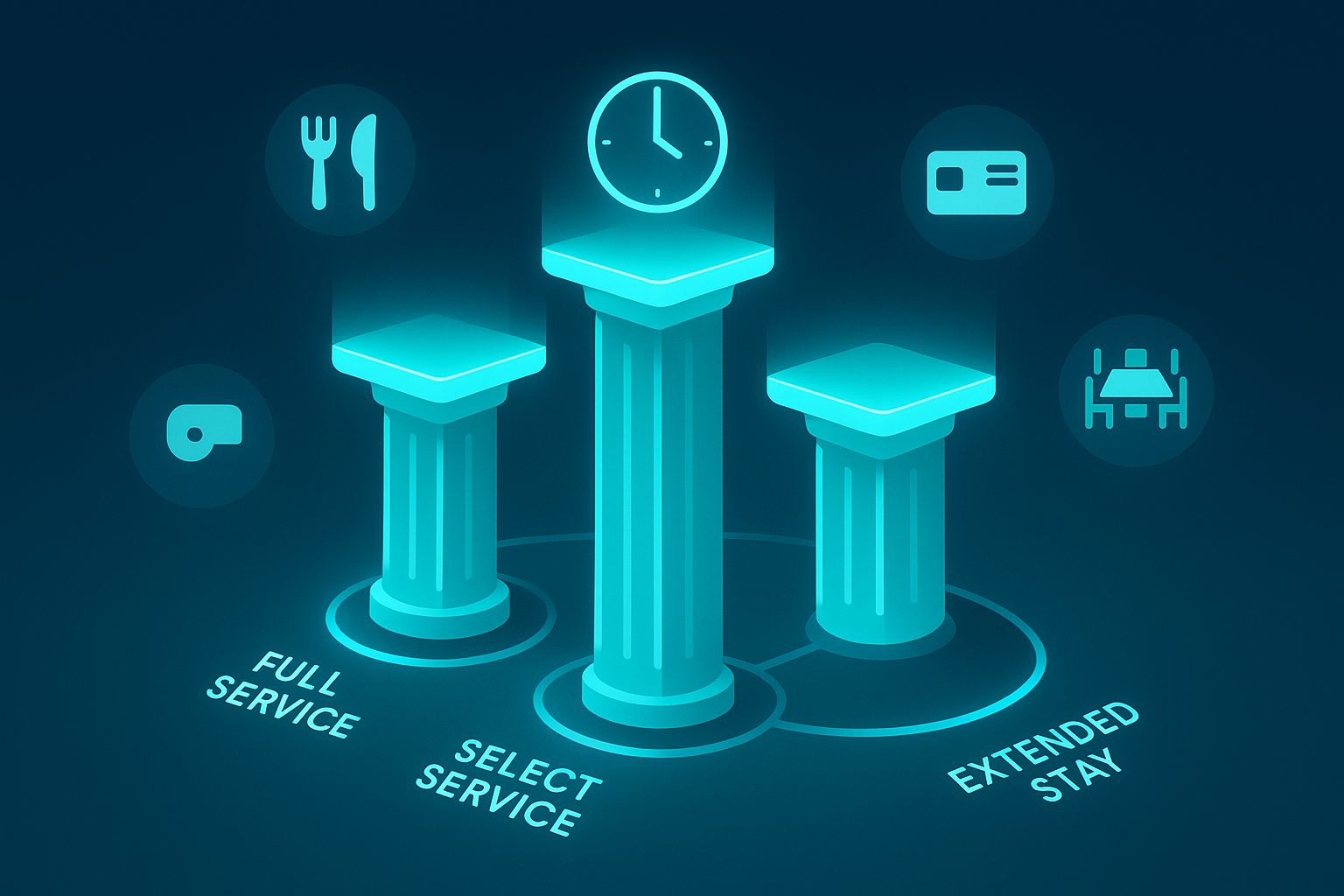
Understanding the three primary hotel franchise models determines your operational requirements, staffing needs, and revenue potential. Full-service properties offer comprehensive amenities including restaurants, room service, concierge, and extensive meeting facilities, targeting business travelers and luxury guests willing to pay premium rates. Select-service hotels focus on essential amenities, comfortable rooms, breakfast, fitness center, and business center, while eliminating costly services like full restaurants, appealing to efficiency-focused travelers.
Extended-stay properties cater to guests requiring accommodations for weeks or months, featuring apartment-style suites with kitchenettes, separate living areas, and weekly housekeeping. These models generate revenue through longer average stays (7-30 nights versus 1-3 nights for traditional hotels) and reduced per-night service costs. Operational complexity varies significantly: full-service requires 0.8-1.2 employees per room, select-service needs 0.3-0.5 employees per room, while extended-stay operates with 0.2-0.4 employees per room due to reduced daily services.
| Model Type | Average Investment | Staffing Ratio | Primary Revenue Sources | Target Guest Segment |
|---|---|---|---|---|
| Full Service | $150,000-$400,000 per room | 0.8-1.2 per room | Rooms (60%), F&B (25%), Events (15%) | Business travelers, luxury leisure |
| Select Service | $80,000-$150,000 per room | 0.3-0.5 per room | Rooms (85%), Limited F&B (10%), Amenities (5%) | Efficiency-focused business and leisure |
| Extended Stay | $70,000-$120,000 per room | 0.2-0.4 per room | Rooms (90%), Laundry/Convenience (10%) | Corporate relocations, project workers |
Comparing Top Hotel Franchise Brands – Wyndham, Sonesta, Cobblestone & More
Selecting the right franchise hotel brand requires evaluating portfolio diversity, fee structures, support systems, and technology platforms. Wyndham Hotels & Resorts operates the world’s largest hotel franchise system with over 20 brands spanning economy to upscale segments, offering franchisees extensive market coverage and proven operational systems. Their fee structure typically includes 5-7% royalties and 3-4% marketing fees, with comprehensive training programs and established reservation systems.
Sonesta International focuses on upscale and luxury segments with brands like Sonesta Hotels and Royal Sonesta, emphasizing personalized service and distinctive property character. Their franchise fees range from 4-6% royalties with 2-3% marketing contributions, targeting markets where premium positioning justifies higher average daily rates. Cobblestone Hotels specializes in smaller markets (populations under 15,000) with new-construction properties, offering 4.5% royalties and comprehensive development support for underserved locations. For insights on identifying the right clientele, see target customer of restaurant.
Brand selection depends on your market dynamics, investment capacity, and operational preferences. Wyndham suits owners seeking proven systems and broad market appeal, Sonesta works for premium markets with higher revenue potential, while Cobblestone excels in smaller communities with limited competition. Technology integration varies significantly, larger brands offer sophisticated property management systems and loyalty programs, while smaller brands provide more personalized support but fewer technological resources.
For more on the intersection of artificial intelligence and hospitality, see this overview of artificial intelligence in the hospitality industry.
Beyond the Brand – Meeting and Exceeding Franchise Operational Requirements
Franchise brand standards encompass service protocols, technology requirements, design specifications, and marketing compliance that directly impact guest satisfaction and revenue performance. Most hotel franchise agreements mandate specific property management systems, point-of-sale platforms, and guest communication tools that ensure brand consistency across locations. Meeting these requirements typically costs 2-4% of gross revenue annually but generates measurable returns through improved operational efficiency and guest loyalty program participation.
AI automation transforms compliance from a cost center into a competitive advantage by streamlining reservation management, automating upselling opportunities, and maintaining consistent guest communication standards. Successful franchisees implement quarterly self-audits using automated systems to track key performance indicators like guest satisfaction scores, revenue per available room, and brand standard adherence. This proactive approach prevents costly compliance issues while identifying optimization opportunities that exceed minimum requirements.
Leveraging AI for Brand Compliance: Vynta agents monitor franchise requirements automatically, ensuring consistent service delivery while identifying upselling opportunities that increase revenue per guest by 15-25%. Our hospitality automation maintains the personal touch that defines exceptional guest experiences while optimizing operational efficiency across reservations, guest services, and revenue management.
To learn more about our approach and company mission, visit our About page.
Technology Trends in Hotel Franchising – Automation, AI, and Guest Experience

AI-powered automation revolutionizes hotel franchise operations by enhancing guest personalization while reducing operational costs and improving staff productivity. Modern hospitality automation systems integrate seamlessly with existing property management platforms to deliver personalized guest communications, optimize room assignments, and identify upselling opportunities based on guest preferences and booking patterns. These systems typically reduce no-show rates by 20-30% through intelligent confirmation sequences and increase ancillary revenue by 20-25%.
For hotel owners interested in leveraging automation for recruitment and staffing, explore our AI-powered recruitment solutions.
Common Pitfalls and How to Avoid Them – The Franchise Owner’s Checklist
Hotel franchise failures often stem from predictable mistakes that savvy owners can prevent with proper planning and systems. Understanding these pitfalls before they impact your operations protects both your investment and brand relationship.
Top 5 Franchise Pitfalls and Solutions
- Underestimating Total Costs: Budget 20-30% above initial projections for unexpected expenses, renovations, and working capital needs
- Brand Standard Violations: Implement quarterly self-audits and AI-powered compliance tracking to maintain consistency
- Poor Staff Training: Create standardized training programs that align with franchise requirements and guest expectations
- Technology Integration Issues: Partner with automation specialists to ensure seamless PMS integration and data flow
- Market Misalignment: Conduct thorough market analysis before selecting franchise brands to ensure local demand matches brand positioning
The most successful hotel franchise owners treat compliance as a competitive advantage rather than a burden. Regular financial reviews, proactive communication with franchisors, and leveraging technology for operational excellence create sustainable growth foundations.
For additional insights on maximizing franchise ROI, check out our real estate solutions for hospitality.
The Future of Hotel Franchising – Trends and Opportunities for Growth
Hotel franchising evolves toward greater operational flexibility, enhanced guest personalization, and sustainable business practices. Technology adoption accelerates as franchise brands recognize AI automation as essential for competitive positioning in the hospitality market.
Market projections indicate 12-15% annual growth in franchise automation adoption, driven by labor cost pressures and guest expectations for seamless digital experiences. Properties that integrate intelligent systems early gain significant advantages in operational efficiency and revenue optimization.
Strategic opportunities emerge for mid-market SMEs willing to embrace human-AI collaboration. Future-focused franchise hotel owners invest in scalable automation platforms, develop staff technology competencies, and create guest experience frameworks that leverage both artificial intelligence and hospitality expertise.
The democratization of sophisticated AI tools enables smaller franchise operators to compete effectively with larger chains, creating sustainable competitive advantages through operational excellence and personalized guest service delivery.
For more information on how to get started or to discuss your hotel franchise needs, connect with our fundraising experts.
Frequently Asked Questions
How does AI automation improve guest experience and operational efficiency in hotel franchises?
AI automation enhances guest experience by enabling personalized communication through chatbots and predictive analytics that optimize pricing and inventory. Operational efficiency improves as AI streamlines reservation management, reduces no-shows, and automates routine tasks, allowing staff to focus on delivering exceptional service.
What are the key components of a hotel franchise agreement that prospective franchisees should carefully review?
Prospective franchisees should carefully review fees (initial and ongoing royalties), brand standards and operational requirements, marketing support, reservation system access, and termination clauses. Understanding these components ensures alignment with the franchise’s expectations and financial commitments.
What are the differences between hotel franchise ownership, management contracts, and direct ownership models?
Hotel franchise ownership involves independent owners licensing a brand while maintaining operational control and paying fees. Management contracts delegate property operations to third-party managers with lower owner control. Direct ownership means full ownership and control without brand licensing or external management.
How can strategic technology adoption contribute to the long-term profitability and competitive advantage of a hotel franchise?
Strategic technology adoption drives profitability by optimizing revenue management, enhancing guest personalization, and improving operational workflows. It provides a competitive edge through data-driven decision-making and scalable automation that supports consistent service quality and cost efficiency across franchise locations.
About The Author
Anas Moujahid is the chief contributing writer & Operations Director for the Vynta Blog, where he turns cutting-edge AI automation into measurable business outcomes for mid-market companies.
Vynta designs enterprise-grade AI agents that augment rather than replace people, freeing teams to focus on higher-value work while the bots handle the busywork.
We specialise in four service-heavy verticals where AI can move the revenue needle fast: real estate, recruitment, fundraising and hospitality.
Anas started his career architecting AI and automation systems; today he leads operations at Vynta, making sure every deployment lands real-world ROI, whether that’s more booked viewings for estate agents, faster placements for recruiters, warmer investor pipelines for fundraisers or happier guests for hotels and restaurants.
Vynta delivers results by:
- Building industry-specific agents pre-trained on real-world workflows, no generic chatbots here.
- Integrating seamlessly with existing CRMs, ATSs, PMSs and fundraising platforms, zero rip-and-replace.
- Measuring success in business KPIs (lead-to-close rates, time-to-hire, donor retention, RevPAR) not vanity metrics.
- Providing transparent implementation plans so clients know exactly what to expect, when and why.
- Pairing every AI agent with human-in-the-loop controls to keep quality, compliance and brand voice on point.
Since launch, Vynta has helped agencies slash lead qualification time by up to 70 %, recruitment firms cut screening hours in half, fundraising teams triple investor touchpoints and hospitality brands lift guest satisfaction scores by double digits, all while keeping human expertise firmly in the loop.
Anas writes with the same ethos that drives Vynta: outcome-focused, jargon-free and grounded in real business value. Expect data-backed insights, practical implementation guides and a clear-eyed view of what AI can, and can’t, do for your organisation.