

Key Takeaways
- Retail customer service has evolved to include AI-powered automation for personalized and proactive experiences.
- Successful retailers use AI to drive measurable revenue growth through advanced customer engagement.
- AI-enabled retail service offers competitive advantages by enabling predictive engagement and intelligent upselling.
- Seamless omnichannel experiences are a key component of modern AI-driven retail customer service.
- Traditional reactive problem-solving is being replaced by AI-based proactive customer service strategies.
Table of Contents
- What Is Retail Customer Service? Defining Modern Excellence
- Why Retail Customer Service Is Crucial for Sustainable Business Success
- Key Elements of Retail Customer Experience: Personalization, Speed, Reliability
- The Power of Customer Segmentation and Personalization in Retail Service
- Omnichannel vs. Single-Channel Retail Customer Service: Which Drives Greater ROI?
- Proactive vs. Reactive Service – How AI Automation Shifts the Customer Experience
- Essential Skills for High-Performing Retail Customer Service Teams
- Training & Supporting Teams for Retail Service Excellence
- Training Action Steps for Immediate Implementation
- Resolving Customer Complaints: Step-by-Step Methodology for Retail
- Best Practices for Delivering Outstanding Retail Customer Service in 2025
- Measuring Retail Customer Service Success: Metrics and Feedback Loops
Retail Customer Service – Driving Real Business Outcomes with AI Automation
Modern retail customer service has evolved far beyond simple transaction support. Today’s most successful retailers leverage AI-powered automation to deliver personalized, proactive experiences that drive measurable revenue growth. While traditional approaches focus on reactive problem-solving, AI-enabled retail service creates competitive advantages through predictive engagement, intelligent upselling, and seamless omnichannel experiences.
The transformation is quantifiable: retailers implementing AI automation report 23% cost reductions, 40% faster response times, and 18% increases in upsell revenue. This shift represents more than a technological upgrade, it’s a fundamental reimagining of how customer interactions drive business outcomes.
What Is Retail Customer Service? Defining Modern Excellence
Retail customer service encompasses all support and assistance provided to shoppers across every touchpoint: in-store interactions, online chat, social media responses, phone support, and AI-powered self-service platforms. Modern excellence requires seamless integration across these channels, creating unified customer experiences regardless of interaction point.
The distinction between traditional and AI-augmented service models is stark. Classic approaches rely on reactive, channel-specific responses, whereas AI-enabled systems proactively anticipate needs, maintain conversation context across platforms, and deliver personalized recommendations based on purchase history and behavior patterns. Learn more about how AI can transform the hospitality sector in our hotel franchise guide.
| Service Channel | Traditional Approach | AI-Augmented Model | Response Time |
|---|---|---|---|
| Live Chat | Manual agent assignment | Intelligent routing with context | 90 seconds vs 3-5 minutes |
| Phone Support | Static call scripts | Dynamic conversation guides | 2 minutes vs 8-12 minutes |
| Email Inquiries | Generic template responses | Personalized, context-aware replies | 1 hour vs 24-48 hours |
| Social Media | Manual monitoring and response | Automated sentiment analysis and priority routing | 15 minutes vs 4-6 hours |
Why Retail Customer Service Is Crucial for Sustainable Business Success
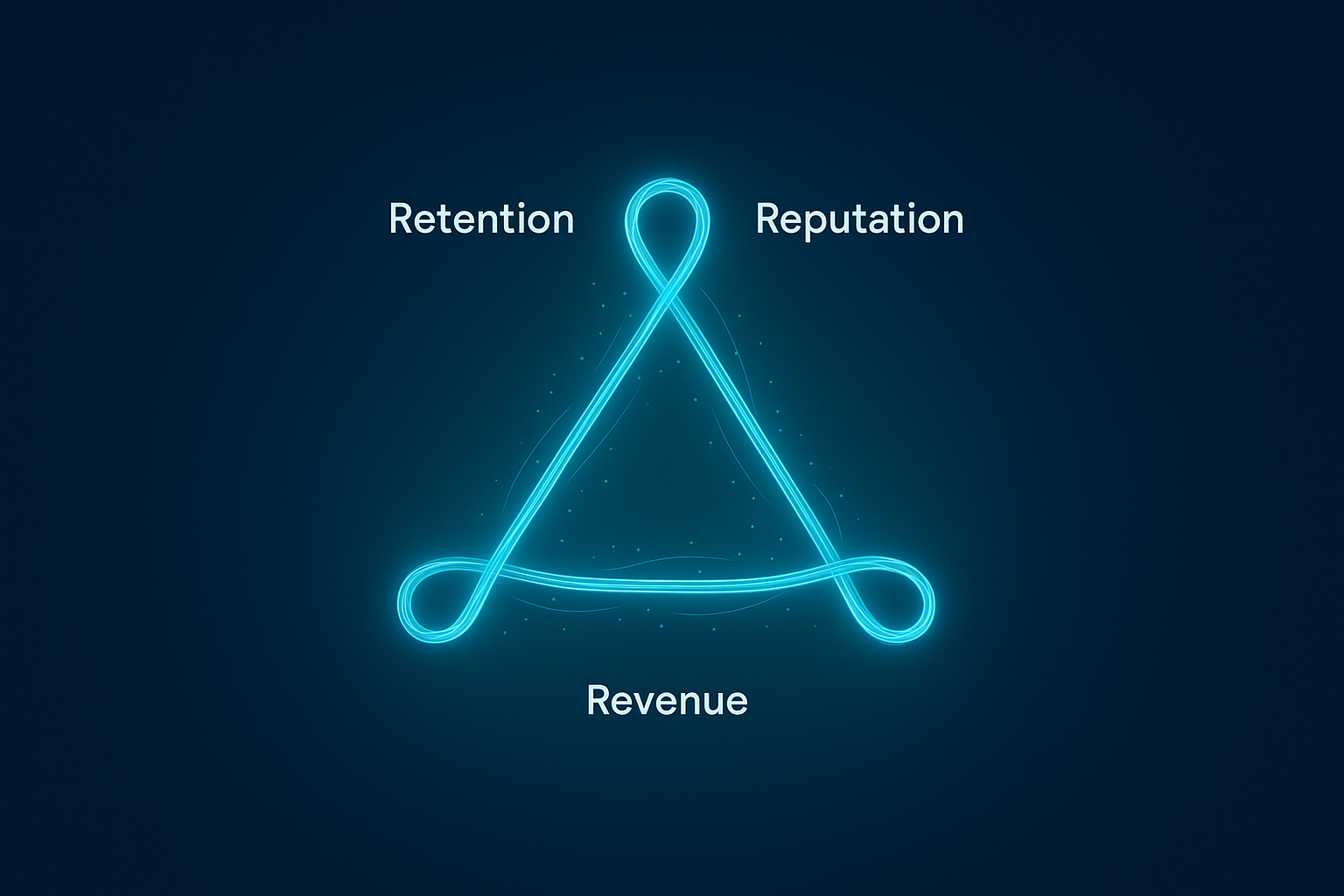
Exceptional customer service in retail directly impacts three critical business metrics: customer retention rates, brand reputation scores, and revenue per customer. Research demonstrates that 95% of consumers will switch brands after a single poor service experience, while companies with superior service achieve 60% higher profit margins than competitors.
The financial impact is measurable and immediate. Retailers implementing comprehensive service strategies see 25% increases in repeat purchase rates, 40% improvements in customer satisfaction scores, and 23% reductions in operational costs through automation. These outcomes compound over time, creating sustainable competitive advantages in increasingly crowded markets.
Service Impact Data: A single positive service interaction increases customer lifetime value by an average of $312, while negative experiences reduce it by $789 across retail categories.
Key Elements of Retail Customer Experience: Personalization, Speed, Reliability
Personalization leverages customer data to deliver tailored interactions, recommendations, and solutions. Effective personalization remembers purchase history, preferences, and previous service interactions to create seamless experiences. AI systems analyze behavioral patterns to predict needs and proactively offer relevant products or services.
Speed in modern retail service means resolving customer inquiries within three minutes or less. This requires intelligent routing systems that connect customers with appropriate resources immediately, whether human agents or AI-powered solutions. Automated responses handle 70% of common inquiries instantly.
Reliability ensures consistent, accurate responses across all channels and interactions. AI-powered knowledge bases maintain up-to-date product information, pricing, and policy details, eliminating discrepancies that frustrate customers and damage trust.
| Service Element | Implementation Method | Measurable Outcome | ROI Timeline |
|---|---|---|---|
| Personalization | AI-driven customer profiling | 18% increase in conversion rates | 3-6 months |
| Speed | Intelligent query routing | 40% reduction in response time | 1-3 months |
| Reliability | Automated knowledge updates | 65% decrease in service errors | 2-4 months |
The Power of Customer Segmentation and Personalization in Retail Service
Effective segmentation divides customers based on purchase frequency, average spend, product preferences, and service history. AI systems automatically tag customers within CRM platforms, enabling service agents to access relevant context immediately. This approach transforms generic interactions into personalized experiences that drive loyalty and revenue.
Dynamic segmentation adapts in real-time as customer behavior evolves. VIP customers receive priority routing and specialized offers, while new customers get onboarding support and educational content. Frequent buyers see recommendations based on their purchase patterns, ensuring every interaction is relevant and timely.
Omnichannel vs. Single-Channel Retail Customer Service: Which Drives Greater ROI?

Omnichannel retail customer service creates a unified experience across web, mobile, messaging, and in-store touchpoints, while single-channel approaches limit interactions to one primary method. The distinction directly impacts revenue: omnichannel shoppers spend 2.5x more than single-channel customers, according to industry research.
| Criteria | Omnichannel Approach | Single-Channel Approach |
|---|---|---|
| Customer Reach | Multiple touchpoints capture diverse preferences | Limited to one communication method |
| Service Consistency | Unified customer profiles across all channels | Fragmented customer history |
| Operational Cost | Higher initial setup, lower per-interaction cost | Lower setup, higher manual handling costs |
| Customer Satisfaction | Seamless experience drives 89% retention | Channel switching creates friction |
Retailers implementing AI-powered omnichannel strategies reduce service overhead by 30% after the first year. A boutique electronics retailer consolidated chat, email, and phone support through intelligent routing, cutting response times from 4 hours to 12 minutes while maintaining personalized service quality.
The ROI advantage becomes clear in customer lifetime value: omnichannel customers show 30% higher retention rates and generate 15% more revenue per transaction through cross-channel upselling opportunities.
Proactive vs. Reactive Service – How AI Automation Shifts the Customer Experience
Proactive Service Definition: Anticipating and preventing customer issues before they occur, versus reactive service that responds after problems arise.
AI agents enable proactive engagement through predictive prompts, automated upselling, and preemptive problem resolution. Instead of waiting for customers to report shipping delays, proactive systems send status updates and alternative solutions before frustration builds.
A home goods retailer slashed abandoned carts by 17% through automated, timely outbound messages triggered when customers pause during checkout. The system detects hesitation patterns and immediately offers assistance or incentives, converting potential losses into completed sales.
Three Steps to Shift from Reactive to Proactive:
- Implement predictive analytics – Monitor customer behavior patterns to identify potential issues 24-48 hours before they escalate
- Automate status communications – Send proactive updates about orders, appointments, or service changes without customer requests
- Deploy intelligent triggers – Set up AI workflows that initiate helpful actions based on customer journey stage or behavioral signals
Retailers using proactive AI strategies report 60% reduction in support tickets and 23% increase in customer satisfaction scores, as customers appreciate being informed rather than left wondering about their purchase status.
Essential Skills for High-Performing Retail Customer Service Teams
High-performing retail customer service requires four critical skills: empathy to understand customer emotions, clear communication to convey solutions effectively, comprehensive product knowledge to provide accurate information, and adaptability to handle diverse situations across multiple channels.
| Skill | Business Outcome | Development Method |
|---|---|---|
| Empathy | 14% increase in service ratings | Scenario-based role-playing, customer feedback review |
| Communication | 25% faster issue resolution | Active listening training, response templates |
| Product Knowledge | 40% improvement in first-call resolution | Interactive product databases, weekly updates |
| Adaptability | 18% higher customer retention | Cross-channel training, situational workshops |
A specialty fashion retailer implemented micro-training sessions focusing on empathy development, using real customer interactions as case studies. Within three months, their service ratings improved by 14%, and customer complaints about “unhelpful staff” dropped by 67%.
Skill gaps are best addressed through on-demand learning platforms integrated with daily workflows. Staff access just-in-time training modules during slower periods, ensuring continuous improvement without disrupting customer service delivery. Regular skills assessments every quarter identify specific areas needing reinforcement.
Training & Supporting Teams for Retail Service Excellence

Effective retail customer service training combines structured onboarding with ongoing skill development through AI-augmented knowledge bases and simulation tools. The goal is maintaining consistency across remote and in-store teams while reducing time-to-competency for new hires.
A structured training program implemented by a multi-location sporting goods retailer reduced onboarding time by 28% while improving new hire confidence scores by 35%. Their approach included interactive product simulations, customer scenario practice, and peer mentoring systems.
Training Action Steps for Immediate Implementation
Three Must-Do Training Actions: Weekly coaching sessions with real customer data review, daily 3-minute team check-ins for issue escalation, and quarterly skills assessments tied to performance metrics.
Weekly coaching sessions using actual customer interactions provide concrete examples of successful resolution techniques. Teams review challenging cases together, identifying what worked and developing standardized approaches for similar future scenarios.
Daily check-ins prevent small issues from becoming major problems. A luxury home goods retailer implemented 3-minute morning huddles where staff share anticipated challenges and receive immediate support, resulting in 22% fewer escalations to management.
AI-augmented knowledge bases serve as real-time support tools during customer interactions. Staff access instant product information, troubleshooting guides, and escalation protocols without leaving their workstation, maintaining conversation flow while ensuring accuracy.
Resolving Customer Complaints: Step-by-Step Methodology for Retail
Effective complaint resolution follows a structured 5-step framework that transforms frustrated customers into loyal advocates through systematic problem-solving and genuine care.
5-Step Complaint Resolution Framework:
- Acknowledge within 1 minute – Immediately confirm receipt and express understanding of the customer’s concern
- Clarify the situation – Ask specific questions to fully understand the problem and its impact
- Resolve with authority – Provide a concrete solution or clear timeline for resolution
- Compensate appropriately – Offer fair compensation when warranted, focusing on relationship repair
- Follow up proactively – Contact the customer within 24-48 hours to ensure satisfaction
AI-powered complaint handling achieves first contact resolution in 82% of cases by automatically classifying issues, suggesting appropriate responses, and escalating complex situations to human agents with full context and recommended solutions.
Fast Complaint Fixes: Billing errors resolved within 5 minutes, product exchanges processed immediately, and service failures addressed with same-day callbacks demonstrate commitment to customer satisfaction.
A home improvement retailer reduced complaint escalation by 45% after implementing AI triage that routes issues based on complexity and customer value, ensuring VIP customers reach senior staff immediately while routine issues receive instant automated solutions.
Best Practices for Delivering Outstanding Retail Customer Service in 2025

Outstanding retail customer service in 2025 combines human warmth with technological efficiency, creating experiences that exceed expectations while driving measurable business results.
Core Service Excellence Tactics:
- Warm, personalized greetings using customer purchase history
- Multi-channel accessibility with seamless handoffs between touchpoints
- Transparent communication about timelines, costs, and next steps
- Proactive follow-up within 24 hours of purchase or service interaction
- Intelligent upselling based on customer preferences and buying patterns
2025 Must-Try Tactics: Automated post-purchase care sequences, predictive restocking notifications for frequent buyers, and micro-surveys after every interaction to capture real-time feedback.
A specialty electronics retailer achieved 95% customer satisfaction by integrating real-time chat with strategic personalization, using AI to surface relevant product recommendations during support conversations and converting 34% of service interactions into additional sales.
Common mistakes to avoid: Generic scripted responses that ignore individual customer context, delayed responses exceeding 4 hours, and failure to follow up on promised actions within stated timeframes.
Measuring Retail Customer Service Success: Metrics and Feedback Loops
Effective retail customer service measurement requires tracking both operational efficiency and customer satisfaction through specific KPIs that directly correlate with business outcomes.
| Metric | Definition | Target Range |
|---|---|---|
| CSAT Score | Customer satisfaction rating post-interaction | 85-95% |
| First Contact Resolution | Issues resolved without follow-up required | 75-85% |
| Average Handle Time | Time from initial contact to resolution | 3-8 minutes |
| Net Promoter Score | Customer likelihood to recommend | 50+ points |
Regular feedback loops increase issue resolution speed by 40% when implemented systematically. A furniture retailer sends 3-question surveys immediately after each interaction, capturing satisfaction, resolution effectiveness, and improvement suggestions while the experience remains fresh.
Feedback in Action: Real-time dashboards showing service metrics enable immediate course correction, while weekly team reviews of customer feedback identify training opportunities and process improvements.
Actionable feedback collection requires timing and simplicity: instant surveys with rating scales, monthly detailed reviews for loyal customers, and social media monitoring for unsolicited feedback that reveals authentic customer sentiment. For further reading on sector-specific AI risk management, see NIST’s expanded guidance on AI risk management.
Frequently Asked Questions
How does AI-powered automation enhance personalization and proactivity in retail customer service?
AI-powered automation analyzes customer data in real time to tailor interactions based on individual preferences and behaviors, enabling highly personalized experiences. It also anticipates customer needs through predictive insights, allowing retailers to engage proactively with relevant offers and support before issues arise.
What are the measurable business benefits retailers experience by implementing AI in customer service?
Retailers using AI-driven customer service report significant improvements including up to 23% cost reductions, 40% faster response times, and an 18% increase in upsell revenue. These outcomes translate into higher operational efficiency, increased customer satisfaction, and measurable revenue growth.
In what ways does AI-driven omnichannel service improve the overall customer experience compared to traditional single-channel approaches?
AI-driven omnichannel service provides seamless, consistent interactions across all customer touchpoints, online, in-store, social media, and more, ensuring customers receive personalized support wherever they engage. This integration reduces friction, improves response speed, and enhances satisfaction compared to isolated single-channel experiences.
How is the shift from reactive to proactive customer service transforming retail interactions and outcomes?
Moving from reactive to proactive service, AI enables retailers to anticipate and address customer needs before they escalate, reducing complaints and no-shows. This shift fosters stronger customer loyalty, increases upselling opportunities, and drives more efficient service delivery, fundamentally improving business outcomes.
About The Author
Anas Moujahid is the chief contributing writer & Operations Director for the Vynta Blog, where he turns cutting-edge AI automation into measurable business outcomes for mid-market companies.
Vynta designs enterprise-grade AI agents that augment rather than replace people, freeing teams to focus on higher-value work while the bots handle the busywork.
We specialise in four service-heavy verticals where AI can move the revenue needle fast: real estate, recruitment, fundraising and hospitality.
Anas started his career architecting AI and automation systems; today he leads operations at Vynta, making sure every deployment lands real-world ROI, whether that’s more booked viewings for estate agents, faster placements for recruiters, warmer investor pipelines for fundraisers or happier guests for hotels and restaurants.
Vynta delivers results by:
- Building industry-specific agents pre-trained on real-world workflows, no generic chatbots here.
- Integrating seamlessly with existing CRMs, ATSs, PMSs and fundraising platforms, zero rip-and-replace.
- Measuring success in business KPIs (lead-to-close rates, time-to-hire, donor retention, RevPAR) not vanity metrics.
- Providing transparent implementation plans so clients know exactly what to expect, when and why.
- Pairing every AI agent with human-in-the-loop controls to keep quality, compliance and brand voice on point.
Since launch, Vynta has helped agencies slash lead qualification time by up to 70 %, recruitment firms cut screening hours in half, fundraising teams triple investor touchpoints and hospitality brands lift guest satisfaction scores by double digits, all while keeping human expertise firmly in the loop.
Anas writes with the same ethos that drives Vynta: outcome-focused, jargon-free and grounded in real business value. Expect data-backed insights, practical implementation guides and a clear-eyed view of what AI can, and can’t, do for your organisation.