

Key Takeaways
- Focusing on customer service enables businesses to dominate in a highly competitive market.
- Customer service has transformed from a reactive role to a proactive revenue driver.
- Companies with superior customer service experience 2.5 times higher revenue growth.
- Such companies retain customers at rates 89% higher than their competitors.
Table of Contents
- Why Customer Service Drives Sustainable Business Growth
- Customer Service vs. Customer Experience vs. Customer Success: What’s the Difference?
- Actionable Techniques to Deliver Standout Customer Service Across Industries
- Fundraising: Building Lasting Donor Relationships
- Hospitality: Creating Memorable Guest Experiences
- Human-AI Collaboration: Augmenting Service Without Losing the Human Touch
- Omnichannel Customer Service: Meeting Customers Where They Are
- Measuring Customer Service Effectiveness: KPIs and Real-World Metrics
- Addressing Common Customer Service Challenges (with AI-powered Solutions)
- Building a Customer-Centric Organization: Culture, Training, and Leadership
- Next Steps: Partnering with Vynta to Elevate Customer Service in Your Industry
Focus on Customer Service: The Strategic Advantage for Modern Businesses
In today’s hyper-competitive landscape, businesses that focus on customer service don’t just survive, they dominate. Customer service has evolved from a reactive support function into a proactive revenue driver that directly impacts your bottom line. Companies with superior customer service experience 2.5x higher revenue growth rates and retain customers at 89% higher rates than their competitors.
The shift is undeniable: modern customers expect instant, personalized, and seamless interactions across every touchpoint. Whether you’re managing property inquiries in real estate, screening candidates in recruitment, nurturing donor relationships in fundraising, or enhancing guest experiences in hospitality, your service quality determines your market position.
Your ability to deliver standout service is increasingly powered by AI-driven solutions that streamline operations and personalize every customer interaction. For an overview of how AI is transforming the industry, learn more about Vynta’s approach.
Why Customer Service Drives Sustainable Business Growth
Customer service excellence generates compounding returns across every business metric that matters. Research shows that 89% of companies now compete primarily on customer experience, with service quality as the primary differentiator. This isn’t just about satisfaction scores, it’s about revenue impact.
Consider the mathematics: acquiring new customers costs 5-25x more than retaining existing ones. A 5% increase in customer retention drives profit increases of 25-95%. In real estate, agents who respond to leads within 5 minutes are 9x more likely to convert them. Recruitment firms with superior candidate experience see 70% higher placement rates. Fundraising organizations with responsive donor service achieve 40% better retention rates.
The hospitality sector demonstrates this most clearly. Hotels with exceptional guest service command 20% higher room rates and achieve 35% better occupancy rates. When Vynta implemented automated guest messaging for a boutique hotel chain, they saw immediate results: 28% increase in direct bookings, 45% reduction in guest complaints, and 22% improvement in online review scores within 90 days.
Modern customer service operates as a strategic asset, not a cost center. It drives word-of-mouth marketing, reduces churn, increases lifetime value, and creates pricing flexibility that directly impacts profitability across all industry verticals.
Customer Service vs. Customer Experience vs. Customer Success: What’s the Difference?
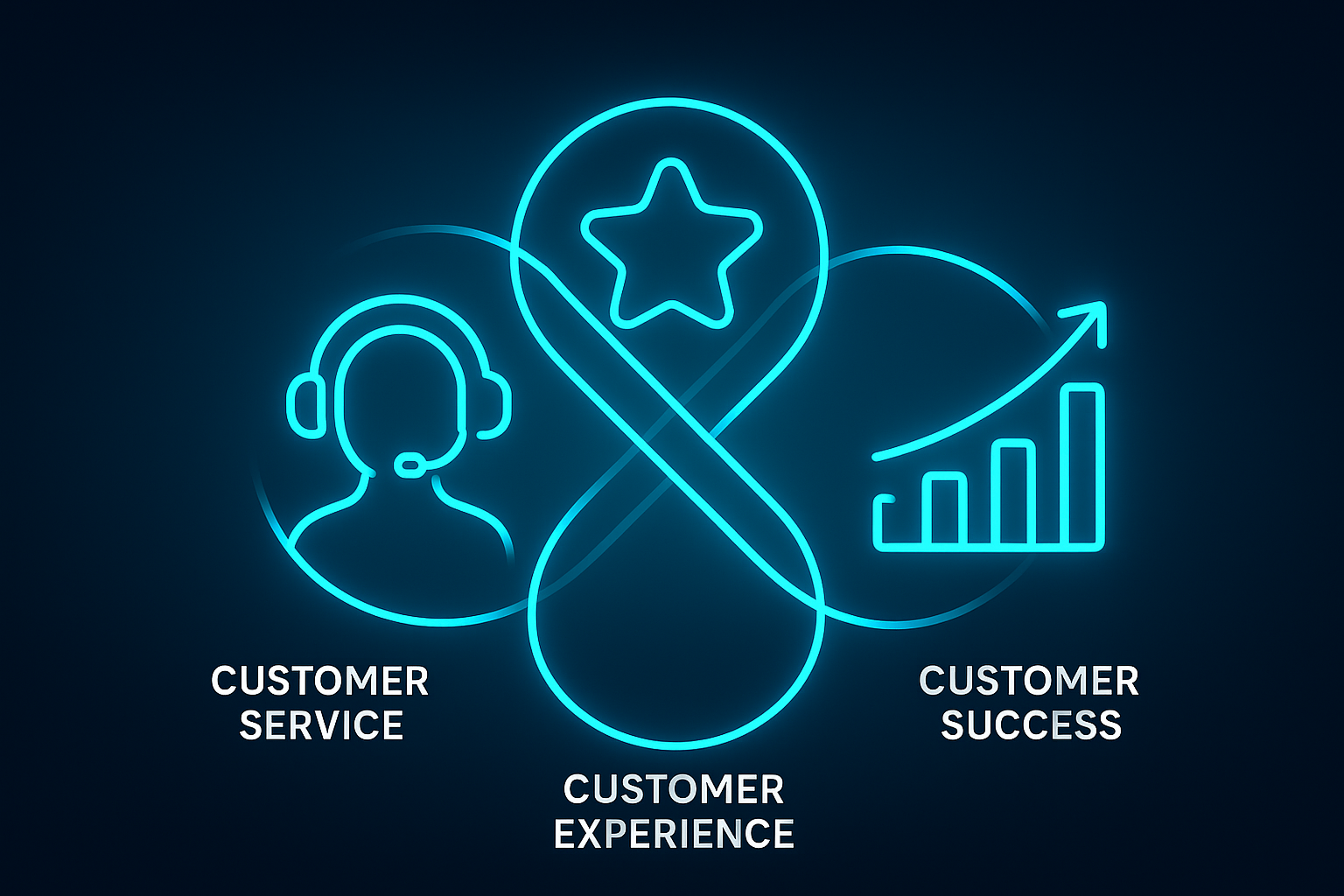
Understanding the distinction between customer service, customer experience, and customer success is crucial for strategic implementation. Each serves different business objectives and requires different approaches, especially when enhanced by AI automation.
| Aspect | Customer Service | Customer Experience | Customer Success |
|---|---|---|---|
| Primary Objective | Resolve issues, answer questions | Create positive interactions | Drive customer outcomes |
| Key Activities | Support tickets, live chat, phone calls | Journey mapping, touchpoint optimization | Onboarding, training, growth planning |
| Measurement Metrics | Response time, resolution rate, CSAT | NPS, journey completion, engagement | Retention, expansion, time-to-value |
| Typical Touchpoints | Help desk, FAQ, support portal | Website, mobile app, in-person interactions | Check-ins, reviews, strategic planning |
In practice, these elements work synergistically. A real estate agency might use AI-powered service to instantly respond to property inquiries (service), ensure seamless viewing scheduling across all channels (experience), and proactively follow up to guide buyers through their purchase journey (success). The key is recognizing that exceptional customer service forms the foundation for superior experience and successful outcomes.
Actionable Techniques to Deliver Standout Customer Service Across Industries
Real Estate: Converting Leads Through Responsive Service
Immediate Response Protocol: Implement AI-powered lead qualification that responds to inquiries within 60 seconds. Set up automated property matching based on stated preferences, then schedule human follow-up within 4 hours. This approach increases lead conversion rates by 35-50%.
Personalized Property Curation: Use AI to analyze client behavior and preferences, automatically sending curated property suggestions twice weekly. Include market insights and neighborhood data. Agents using this technique see 40% higher client engagement and 25% faster sales cycles.
Recruitment: Enhancing Candidate and Client Experience
Automated Interview Coordination: Deploy AI agents to handle initial candidate screening and interview scheduling within 24 hours of application. Provide real-time status updates to both candidates and clients. This reduces time-to-hire by 45% while improving candidate satisfaction scores.
Proactive Communication Loops: Set up automated weekly updates for clients on search progress and candidate feedback. This transparency builds trust and demonstrates commitment to successful placements.
Key Insight
Companies that focus on customer service in recruitment see 40% higher client retention rates and 25% more referral business compared to those prioritizing speed alone.
Fundraising: Building Lasting Donor Relationships
Personalized Stewardship at Scale: Use AI to analyze donor giving patterns, preferences, and communication history to craft highly personalized thank-you messages and impact reports. This approach increases donor retention by 35% while reducing administrative overhead.
Transparent Impact Communication: Implement automated quarterly impact reports that show donors exactly how their contributions made a difference. Include specific metrics, stories, and photos relevant to their interests. This builds trust and encourages continued giving.
Multi-Channel Engagement Strategy: Meet donors where they are, email for detailed updates, SMS for urgent campaigns, phone calls for major gift discussions, and in-person events for relationship building. AI helps orchestrate timing and channel selection based on donor preferences.
For organizations looking to elevate their donor relationships, discover how AI-powered fundraising solutions can help you build lasting connections and increase retention.
Hospitality: Creating Memorable Guest Experiences

Anticipatory Service Delivery: Use guest data and AI insights to anticipate needs before they’re expressed. Pre-arrival room customization, dietary preference accommodation, and activity recommendations based on past stays create “wow” moments that drive repeat bookings.
Real-Time Issue Resolution: Implement 24/7 AI-powered guest messaging that escalates complex issues to human staff within minutes. Quick resolution of problems, from room temperature adjustments to restaurant reservations, turns potential negative experiences into positive ones.
Revenue-Generating Upsells: Train staff to identify natural upselling opportunities through AI-generated guest profiles. Suggesting spa treatments to stressed business travelers or wine pairings to food enthusiasts feels helpful, not pushy, when timed correctly.
Human-AI Collaboration: Augmenting Service Without Losing the Human Touch
The fear that AI will replace human customer service representatives is misguided. Instead, AI serves as a powerful amplifier of human capabilities, handling routine tasks while freeing staff to focus on complex, relationship-building activities that require emotional intelligence and creative problem-solving.
AI Handles the Routine, Humans Handle the Complex: AI excels at data retrieval, appointment scheduling, basic FAQ responses, and initial inquiry triage. Humans excel at negotiation, conflict resolution, emotional support, and creative solution development. This division of labor maximizes both efficiency and satisfaction.
| Task Category | AI-Powered Automation | Human Expertise | Business Impact |
|---|---|---|---|
| Information Gathering | Property details, candidate backgrounds, donor history | Reading between the lines, understanding motivations | 50% faster qualification process |
| Initial Communication | Welcome messages, confirmation emails, status updates | Complex negotiations, sensitive conversations | 24/7 responsiveness with personal touch |
| Problem Resolution | Standard solutions, policy explanations, escalation triggers | Creative solutions, exception handling, relationship repair | 80% first-contact resolution rate |
| Relationship Building | Preference tracking, interaction history, timing optimization | Trust building, strategic advice, emotional connection | 35% higher customer lifetime value |
This collaborative approach addresses the common concern: “Will AI make my team redundant?” The answer is emphatically no. AI makes your team more valuable by eliminating tedious tasks and providing data-driven insights that enhance human decision-making. Staff report higher job satisfaction when freed from repetitive work to focus on meaningful customer relationships.
Omnichannel Customer Service: Meeting Customers Where They Are
Modern customers expect seamless support across all touchpoints, email, chat, phone, social media, and in-person interactions. Omnichannel service ensures consistent experiences regardless of communication channel, with complete context preservation as conversations move between platforms.
Single Customer View Implementation: Integrate all customer touchpoints into one unified dashboard. When a property buyer calls after submitting an online inquiry, your agent immediately sees their browsing history, preferences, and previous conversations. This eliminates frustrating repetition and demonstrates professionalism.
Intelligent Routing and Escalation: AI automatically routes inquiries to the most appropriate team member based on complexity, urgency, and expertise required. High-value real estate leads get immediate attention, while routine scheduling requests are handled efficiently through automation.
Context Preservation Across Channels: Conversations that start via website chat continue seamlessly when the customer calls or visits in person. Staff have complete interaction history, preferences, and previous solutions attempted. This continuity builds trust and accelerates resolution times by 60%.
For a deeper dive into best practices, see these customer experience improvement strategies and best practices.
Measuring Customer Service Effectiveness: KPIs and Real-World Metrics

Effective customer service measurement goes beyond satisfaction surveys to include leading indicators that predict business outcomes. The key is tracking metrics that directly correlate with revenue, retention, and operational efficiency across your specific industry vertical.
Response Time: Track the average time to first response across all channels. In real estate, a sub-5-minute response window increases lead conversion by up to 9x. In hospitality, instant guest messaging reduces complaint escalation by 45%.
Resolution Rate: Monitor the percentage of inquiries resolved on first contact. Recruitment agencies with 80%+ first-contact resolution see 25% higher client satisfaction scores.
Customer Satisfaction (CSAT) and Net Promoter Score (NPS): Use post-interaction surveys to measure satisfaction and loyalty. Fundraising organizations that track donor NPS see 40% higher retention rates.
Operational Efficiency: Measure reduction in manual workload and time spent per inquiry. Hospitality businesses using AI-powered automation report a 30% decrease in staff hours spent on routine tasks.
By focusing on these KPIs, organizations can directly link customer service improvements to measurable business outcomes, ensuring that investments in AI and process optimization deliver real ROI.
Addressing Common Customer Service Challenges (with AI-powered Solutions)
Modern businesses face predictable customer service obstacles that drain resources and damage relationships. The most critical challenges, overwhelming inquiry volume, difficult customer interactions, extended response times, and inconsistent service quality, can be systematically addressed through strategic AI implementation.
Difficult Customer Interactions: AI sentiment analysis identifies frustrated customers early, triggering immediate escalation protocols. Recruitment agencies use AI to monitor candidate feedback sentiment, proactively addressing concerns before they become negative reviews. Real-time coaching prompts help staff navigate challenging conversations with data-driven talking points.
Long Response Times: Automated acknowledgment systems provide instant confirmation while AI gathers relevant information. Fundraising organizations deploy AI assistants that immediately acknowledge donor inquiries and provide preliminary information while human staff prepare personalized responses. This approach reduces perceived wait times by 60% even when actual resolution times remain unchanged.
Inconsistent Service Quality: AI ensures standardized responses while preserving personalization. Knowledge base AI provides staff with consistent, accurate information regardless of experience level. In hospitality, AI-powered service scripts adapt to guest preferences while maintaining brand standards across all touchpoints.
For further reading, explore the customer service overview on Wikipedia.
Building a Customer-Centric Organization: Culture, Training, and Leadership
Sustainable customer service excellence requires organizational transformation beyond technology implementation. Leadership must systematically embed customer focus into hiring practices, training programs, performance metrics, and daily operations.
Leadership Foundation: Establish customer-centric hiring criteria that prioritize empathy and problem-solving skills. Create cross-departmental customer story sessions where teams share success stories and learn from service failures. Real estate agencies that implement weekly “customer win/loss” reviews using AI-generated insights see 25% higher client satisfaction scores.
Training and Development: Design role-specific training programs that combine soft skills with AI tool proficiency. Recruitment firms benefit from training programs that teach consultants to leverage AI candidate insights while building authentic relationships. Ongoing education ensures teams adapt as AI capabilities expand.
Performance Integration: Align compensation and recognition systems with customer satisfaction metrics. Track individual and team performance using AI-generated analytics that identify coaching opportunities. Hospitality managers who tie bonuses to guest satisfaction scores and AI-measured service consistency achieve 40% lower staff turnover.
Continuous Improvement Culture: Establish feedback loops where customer insights drive process refinements. Use AI analytics to identify service patterns and proactively address emerging issues. Organizations that combine human intuition with AI-driven insights create self-improving customer service systems.
For more actionable strategies on building a customer-centric culture, check out our blog post on recruitment best practices for customer service teams.
Next Steps: Partnering with Vynta to Elevate Customer Service in Your Industry

Transforming customer service requires strategic partnership with AI specialists who understand your industry’s unique challenges. Vynta’s proven implementation process delivers measurable results within 90 days while preserving the human relationships that drive business success.
Engagement Process: Our discovery phase analyzes your current service workflows and identifies high-impact automation opportunities. We develop ROI roadmaps specific to your vertical, whether optimizing real estate lead response, streamlining recruitment candidate communication, enhancing fundraising donor relations, or elevating hospitality guest experiences. Pilot programs validate effectiveness before full-scale deployment.
| Capability | Vynta | Generic Tools | Enterprise Platforms |
|---|---|---|---|
| Industry Specialization | Deep expertise in 4 verticals | One-size-fits-all approach | Complex customization required |
| Implementation Timeline | 4-6 weeks to go live | Months of configuration | 6-12 months typical |
| Human-AI Integration | Designed to augment teams | Basic automation only | Often replaces human roles |
| ROI Measurement | Industry-specific KPIs | Generic metrics | Complex reporting systems |
Competitive Advantage: Vynta’s industry-specific approach means your real estate agency gets lead qualification systems that understand property matching, not generic chatbots. Your recruitment firm receives candidate screening AI trained on hiring patterns, not basic resume filters. This specialization delivers faster implementation, higher adoption rates, and measurable business impact that generic solutions cannot match.
To get started, contact our team for a personalized consultation and see how Vynta can help your business thrive.
Frequently Asked Questions
How does proactive customer service contribute to higher revenue growth and customer retention?
Proactive customer service anticipates and addresses customer needs before issues arise, creating a seamless and personalized experience that builds trust and loyalty. This approach reduces churn and increases repeat business, driving revenue growth up to 2.5 times higher and improving retention rates by 89% compared to reactive service models.
What are the key differences between customer service, customer experience, and customer success?
Customer service focuses on direct support and problem resolution, often reactive in nature. Customer experience encompasses the entire journey a customer has with a brand, including every interaction and emotional response. Customer success is a proactive, strategic approach aimed at ensuring customers achieve their desired outcomes, fostering long-term loyalty and value realization.
In what ways can AI-powered solutions enhance customer service without losing the human touch?
AI-powered solutions automate routine tasks, personalize interactions, and provide real-time insights, enabling staff to focus on complex, empathetic engagements. By augmenting human capabilities rather than replacing them, AI helps deliver faster, more consistent service while preserving the personal connection that defines exceptional customer care.
How can businesses measure the effectiveness of their customer service efforts using KPIs and real-world metrics?
Businesses can track KPIs such as customer satisfaction scores (CSAT), Net Promoter Score (NPS), first response time, resolution time, and customer retention rates. These metrics provide actionable insights into service quality, operational efficiency, and the impact on revenue growth, enabling continuous improvement aligned with business goals.
About The Author
Anas Moujahid is the chief contributing writer & Operations Director for the Vynta Blog, where he turns cutting-edge AI automation into measurable business outcomes for mid-market companies.
Vynta designs enterprise-grade AI agents that augment rather than replace people, freeing teams to focus on higher-value work while the bots handle the busywork.
We specialise in four service-heavy verticals where AI can move the revenue needle fast: real estate, recruitment, fundraising and hospitality.
Anas started his career architecting AI and automation systems; today he leads operations at Vynta, making sure every deployment lands real-world ROI, whether that’s more booked viewings for estate agents, faster placements for recruiters, warmer investor pipelines for fundraisers or happier guests for hotels and restaurants.
Vynta delivers results by:
- Building industry-specific agents pre-trained on real-world workflows, no generic chatbots here.
- Integrating seamlessly with existing CRMs, ATSs, PMSs and fundraising platforms, zero rip-and-replace.
- Measuring success in business KPIs (lead-to-close rates, time-to-hire, donor retention, RevPAR) not vanity metrics.
- Providing transparent implementation plans so clients know exactly what to expect, when and why.
- Pairing every AI agent with human-in-the-loop controls to keep quality, compliance and brand voice on point.
Since launch, Vynta has helped agencies slash lead qualification time by up to 70 %, recruitment firms cut screening hours in half, fundraising teams triple investor touchpoints and hospitality brands lift guest satisfaction scores by double digits, all while keeping human expertise firmly in the loop.
Anas writes with the same ethos that drives Vynta: outcome-focused, jargon-free and grounded in real business value. Expect data-backed insights, practical implementation guides and a clear-eyed view of what AI can, and can’t, do for your organisation.