

Key Takeaways
- “Operation Talent” refers to both a significant cybercrime takedown and a strategic workforce management function.
- Law enforcement’s Operation Talent targeted and dismantled cybercrime marketplaces that endangered business data.
- Talent operations is transforming how organizations attract, develop, and retain their workforce.
- Effective talent operations are crucial for safeguarding business growth and securing valuable human assets.
Table of Contents
- Operation Talent, What It Means for Modern Businesses
- The Cybercrime Origin of “Operation Talent”, Lessons for Business Leaders
- Dark Web Monitoring, A Non-Negotiable for Modern Talent Operations
- What Is Talent Operations? A Strategic Redesign of HR
- Talent Operations vs. Talent Acquisition, Talent Management & HR Operations, Crucial Differences
- Core Responsibilities & Roles Within a High-Impact Talent Operations Team
- How to Build a Modern Talent Operations Function, A Stepwise Guide
- The Role of Data & Analytics in Talent Operations, Turning Insights Into Actions
- Optimizing the Hiring Journey, Automation, Tech Stack, and Human-AI Collaboration
- Best Practices for Scaling Talent Operations That Drive Measurable ROI
- Solving Common Talent Operations Challenges, Field-Tested Solutions
- Talent Operations Technology Stack, Choosing, Integrating & Measuring What Matters
Operation Talent: Revolutionizing Talent Operations and Safeguarding Business Growth
The term “operation talent” carries dual significance in today’s business landscape, representing both a major cybercrime takedown and the strategic function transforming how organizations manage their workforce. While law enforcement’s Operation Talent dismantled cybercrime marketplaces threatening business data, talent operations as a discipline revolutionizes how companies attract, develop, and retain their most valuable asset: people.
For mid-market SMEs across real estate, recruitment, fundraising, and hospitality, understanding both contexts is crucial. The cybersecurity implications protect your candidate and employee data, while modern talent operations drive measurable improvements in hiring efficiency, retention rates, and ultimately, revenue growth.
The Cybercrime Origin of “Operation Talent”, Lessons for Business Leaders

Operation Talent represented a coordinated international effort targeting the Cracked and Nulled cybercrime marketplaces, which facilitated over $4 million in illegal transactions and compromised data from 17 million U.S. victims. The operation, launched in 2024, resulted in multiple arrests and the seizure of domains hosting databases containing 500,000+ stolen identities.
These marketplaces specifically traded in credentials that SMEs handle daily: employee login information, candidate personal data, and customer records. For recruitment agencies managing thousands of candidate profiles, hospitality businesses storing guest payment information, or real estate firms handling client financial data, the breach implications extend far beyond immediate financial loss to long-term reputational damage and regulatory penalties.
The operation’s scale demonstrates why even boutique businesses must implement enterprise-grade security measures. Monthly audits of HR technology stacks, mandatory multi-factor authentication, and continuous dark web monitoring aren’t luxuries, they’re operational necessities that protect both talent operations and broader business continuity.
Dark Web Monitoring, A Non-Negotiable for Modern Talent Operations
Dark web forums operate as active trading posts for stolen HR data, including candidate resumes, employee records, and internal communications. Organizations managing talent data face constant exposure risk, making proactive monitoring essential for operational integrity.
Effective dark web monitoring platforms provide continuous scanning with actionable alerts, typically detecting compromised data within 24-48 hours of initial posting. This speed advantage allows talent operations teams to implement immediate containment measures, notify affected individuals, and prevent secondary exploitation.
Three immediate steps for SMEs:
- Configure automated weekly scans for all HR system domains and employee email patterns
- Establish mandatory password rotation policies with unique credentials for each platform
- Create incident response playbooks linking monitoring alerts to specific containment actions
When candidate data appears on dark web marketplaces, immediate notification and credit monitoring services demonstrate professional responsibility while preserving your talent pipeline’s trust and engagement.
What Is Talent Operations? A Strategic Redesign of HR
Talent operations transforms workforce management from reactive administration to proactive business strategy. Unlike traditional HR functions focused on compliance and employee relations, talent ops optimizes every touchpoint in the employee lifecycle using data analytics, process automation, and predictive insights.
The discipline encompasses end-to-end process design across recruitment, onboarding, internal mobility, performance management, and retention strategies. Organizations implementing dedicated talent operations functions report 35-50% improvements in time-to-hire and 25-40% increases in new hire retention rates within the first year.
| Industry | Primary Talent Ops Focus | Key Automation Opportunity |
|---|---|---|
| Real Estate | Agent onboarding and certification tracking | Automated license renewal alerts and training assignments |
| Recruitment | Candidate experience optimization | Automated interview scheduling and feedback collection |
| Fundraising | Donor engagement and stewardship | Automated donor communications and pledge tracking |
| Hospitality | Guest service onboarding and upselling | Automated training modules and upsell prompts |
Talent Operations vs. Talent Acquisition, Talent Management & HR Operations, Crucial Differences
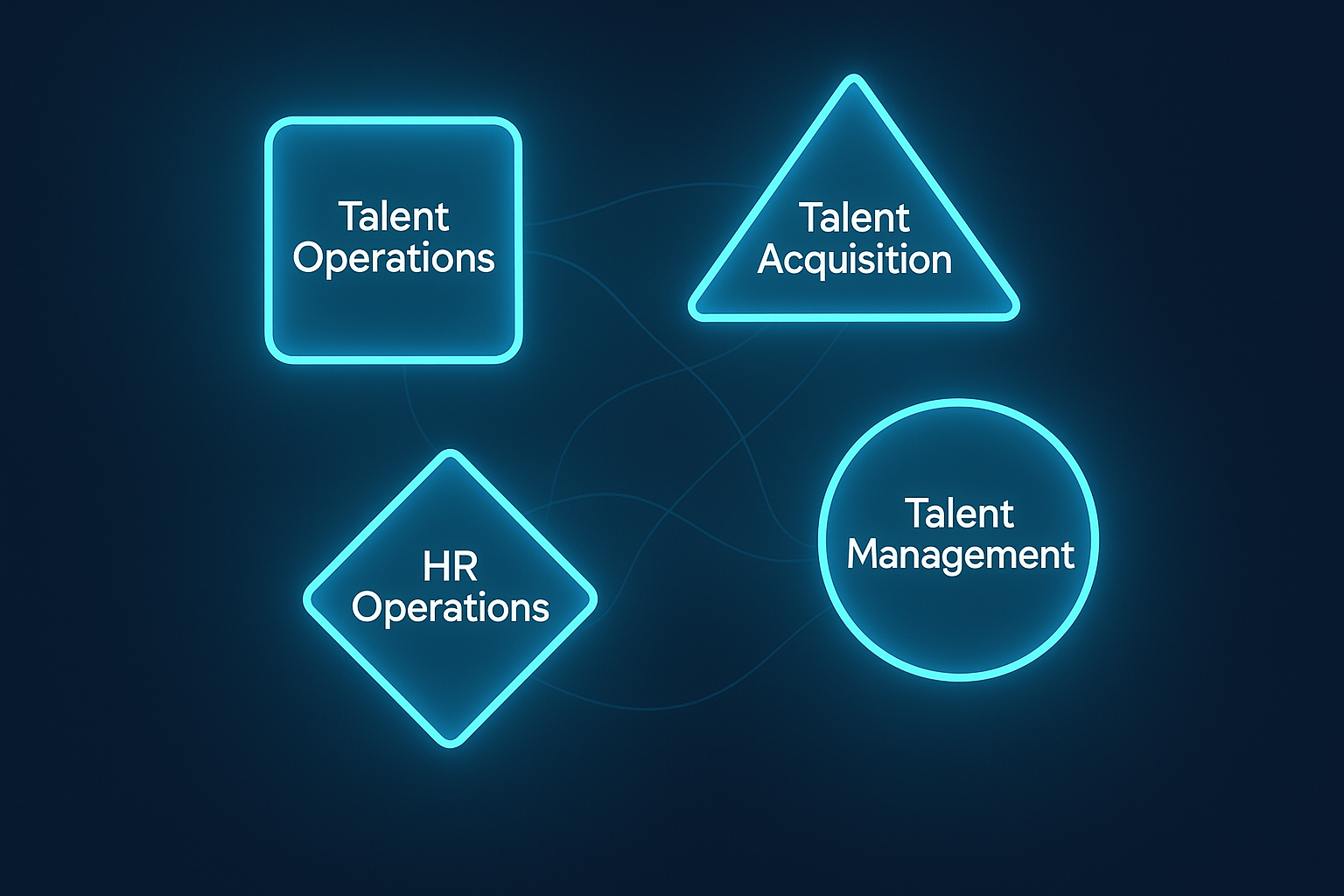
Understanding the distinct roles of each talent function prevents misallocated resources and ensures proper strategic focus. While these disciplines overlap, their objectives, methodologies, and success metrics differ significantly.
| Function | Primary Objective | Core Activities | Key Metrics | Tech Stack Focus |
|---|---|---|---|---|
| Talent Operations | Process optimization across entire employee lifecycle | Workflow design, analytics, system integration | Time-to-hire, process efficiency, ROI | Automation platforms, analytics dashboards |
| Talent Acquisition | Finding and hiring qualified candidates | Sourcing, interviewing, offer negotiation | Quality of hire, source effectiveness | ATS, sourcing tools, interview platforms |
| Talent Management | Developing existing employee capabilities | Performance reviews, career planning, succession | Retention rates, internal mobility, engagement | LMS, performance management systems |
| HR Operations | Administrative compliance and employee services | Payroll, benefits, policy enforcement | Processing accuracy, compliance rates | HRIS, payroll systems, benefits platforms |
A hospitality manager implementing new reservation software shouldn’t expect their ATS administrator to handle integration analytics, that’s talent operations territory. Similarly, onboarding analytics ownership belongs with talent ops, not traditional HR administration, because it directly impacts hiring velocity and new employee productivity.
Core Responsibilities & Roles Within a High-Impact Talent Operations Team
Effective talent operations teams blend analytical rigor with operational execution across four specialized roles: Talent Operations Manager, Operations Analyst, Technology Integration Lead, and Process Improvement Specialist. Each role addresses specific aspects of workforce optimization while maintaining cross-functional collaboration.
The Talent Operations Manager orchestrates strategic initiatives, manages vendor relationships, and translates business requirements into operational workflows. At a recruitment agency, this role might spend mornings analyzing candidate pipeline metrics and afternoons training hiring managers on new interview protocols. The Technology Integration Lead ensures seamless data flow between ATS, CRM, and analytics platforms, critical for real estate agencies managing both property listings and agent performance data simultaneously.
Top 5 Required Skills by Role:
- Operations Manager: Strategic thinking, stakeholder management, data interpretation, project leadership, change management
- Analyst: Statistical analysis, dashboard creation, trend identification, reporting automation, data visualization
- Tech Lead: System integration, API management, workflow automation, troubleshooting, security protocols
- Process Improvement Specialist: Lean process design, root cause analysis, change facilitation, cross-functional training, documentation
As organizations scale from 50 to 500+ employees, these roles evolve from individual contributors handling multiple functions to specialized teams with dedicated focus areas, requiring continuous skill development and cross-training to maintain operational flexibility.
How to Build a Modern Talent Operations Function, A Stepwise Guide
Successful talent operations implementation follows a systematic four-phase approach that minimizes disruption while maximizing immediate impact. Organizations rushing into advanced automation without foundational process mapping typically experience 60-70% higher implementation failure rates.
Step 1: Map the Complete Talent Journey – Document every touchpoint from initial candidate contact through employee departure, identifying bottlenecks, redundancies, and data gaps. Real estate agencies often discover that agent onboarding involves 15-20 separate systems without integration.
Step 2: Audit Current Technology Infrastructure – Assess existing HR, ATS, and CRM platforms for integration capabilities, data quality, and automation potential. Prioritize systems with open APIs and established connector ecosystems.
Step 3: Define Priority Metrics and Benchmarks – Establish baseline measurements for time-to-hire, cost-per-hire, offer acceptance rates, and new hire performance at 30, 60, and 90 days. Industry benchmarks vary significantly, hospitality roles average 14 days to hire while specialized recruitment positions require 35-45 days.
Step 4: Implement Continuous Improvement Cycles – Schedule monthly stakeholder reviews with specific agenda items: metric performance, process bottlenecks, technology optimization opportunities, and upcoming business requirements. One boutique hotel group reduced agent onboarding from 10 days to 3 days using Vynta’s automated workflow orchestration, directly impacting revenue during peak booking seasons.
The Role of Data & Analytics in Talent Operations, Turning Insights Into Actions
Data-driven talent operations transforms hiring from intuitive guesswork into predictable business outcomes. Organizations implementing comprehensive analytics report 40-60% improvements in hiring manager satisfaction and 25-35% reductions in new hire turnover within six months.
High-impact KPIs span the entire talent lifecycle: source-of-hire effectiveness, interview-to-offer conversion rates, candidate Net Promoter Scores, time-to-productivity metrics, and predictive flight risk indicators. Real-time dashboards consolidating ATS, CRM, and performance data enable immediate course corrections rather than quarterly retrospectives.
Three proven analytics techniques drive measurable improvements:
- Predictive Analytics: Use historical hiring and performance data to forecast candidate success and retention risk.
- Funnel Analysis: Track conversion rates at each hiring stage to identify and address bottlenecks.
- Engagement Scoring: Measure candidate and employee engagement through survey data and communication response rates.
Optimizing the Hiring Journey, Automation, Tech Stack, and Human-AI Collaboration
Modern operation talent strategies succeed through intelligent automation that amplifies human decision-making rather than replacing it. Industry benchmarks reveal AI-powered screening reduces manual resume review by 65-70% while maintaining quality standards across real estate, recruitment, fundraising, and hospitality sectors.
Three automation implementations deliver immediate ROI:
Calendar Integration Automation: Automated interview scheduling with two-way calendar syncs reduces candidate no-shows by 30% and eliminates 4-6 hours of weekly coordination for hiring managers.
Conversational AI handles first-round candidate screening with industry-specific questionnaires. Hospitality managers deploy automated assessments for menu knowledge and service protocols, while real estate agencies screen for licensing status and market familiarity. This approach processes 3x more candidates while maintaining personalized touchpoints.
Onboarding task automation triggers sequential reminders at predetermined intervals, day 1 system access, day 3 training modules, day 7 manager check-ins. Vynta’s pre-built integrations connect seamlessly with existing ATS, CRM, and property management systems across all four verticals.
Human-in-the-loop best practices preserve relationship quality: operations teams review AI-generated candidate summaries before final decisions, customize automated messaging templates monthly, and maintain direct oversight of offer negotiations and salary discussions.
Best Practices for Scaling Talent Operations That Drive Measurable ROI
Mature operation talent functions operate on continuous improvement cycles with measurable benchmarks. High-performing organizations achieve average time-to-fill of 18-22 days, cost-per-hire below $3,200, and new-hire retention rates exceeding 85% at 12 months.
| Metric | Industry Average | Top Quartile | Best Practice Impact |
|---|---|---|---|
| Time-to-Fill | 36 days | 18-22 days | 40% reduction |
| Cost-per-Hire | $4,700 | $3,200 | 32% savings |
| Offer Acceptance Rate | 68% | 87% | 28% improvement |
Three advanced scaling practices separate leaders from followers:
Bi-weekly Process Review Sprints: Cross-functional teams analyze conversion rates at each hiring stage, identify bottlenecks, and implement solutions within 48-hour cycles. Real estate agencies using this approach reduce “ghosted” candidate rates by 40% through improved communication touchpoints.
Cross-Department Synchronization: Weekly alignment meetings between talent operations, sales, and operations teams ensure hiring priorities match business demands. Hospitality managers coordinate seasonal hiring surges with occupancy forecasts, preventing understaffing during peak periods.
Automated Feedback Integration: Post-interview surveys from candidates and hiring managers feed directly into process optimization algorithms. Data-driven adjustments to interview formats, communication cadence, and decision timelines occur monthly rather than annually.
Solving Common Talent Operations Challenges, Field-Tested Solutions

Data fragmentation across multiple systems creates the most persistent challenge in operation talent management. Organizations typically maintain candidate information in 3-5 disconnected platforms, ATS, CRM, email, spreadsheets, and communication tools.
Solution: Single-source-of-truth dashboards aggregate all touchpoints into unified candidate profiles. Vynta’s integration capabilities connect existing systems without requiring platform migrations, preserving historical data while enabling real-time visibility.
Challenge #2: Low hiring manager adoption stems from complex interfaces and time-consuming data entry requirements. Busy real estate brokers and restaurant managers abandon systems that add administrative burden.
Solution: Mobile-first interfaces with voice-to-text interview notes and one-click candidate evaluations increase usage rates by 75%. Instant reporting capabilities provide hiring managers with immediate insights without manual dashboard navigation.
Challenge #3: Talent pipeline shortages in competitive markets require proactive sourcing strategies beyond traditional job postings. Hospitality and fundraising sectors face particularly acute talent scarcity.
Hospitality Scenario: A boutique hotel group preparing for high season implements passive candidate nurturing campaigns six months in advance, building relationships with seasonal workers through automated touchpoints and exclusive job previews. Result: 90% staffing completion two weeks before peak season.
Employer branding automation maintains consistent candidate communication even when positions aren’t immediately available, creating warm pipelines for future openings. For additional insights on federal AI strategy and workforce security, see the Accelerating Federal Use of AI through Innovation, Governance, and Public Trust memorandum.
Talent Operations Technology Stack, Choosing, Integrating & Measuring What Matters
Strategic technology selection prioritizes integration capabilities and measurable business impact over feature quantity. Successful operation talent implementations focus on core functionality that delivers immediate ROI across recruitment, onboarding, and retention processes.
Essential technology components by vertical:
- Real Estate: CRM integration with MLS systems, automated lead-to-candidate tracking, commission calculation tools
- Recruitment: Advanced ATS with sourcing automation, candidate relationship management, and analytics dashboards
- Fundraising: Donor CRM with automated outreach, pledge tracking, and engagement analytics
- Hospitality: Reservation system integration, guest experience automation, upsell and feedback modules
For a broader perspective on national security and AI, review the Memorandum on Advancing the United States Leadership in Artificial Intelligence.
Frequently Asked Questions
What is the dual significance of the term ‘Operation Talent’ in today’s business environment?
The term ‘Operation Talent’ refers both to a major international cybercrime takedown targeting illegal marketplaces compromising millions of identities, and to the strategic function of talent operations that transforms how organizations attract, develop, and retain their workforce to drive business growth.
How did the law enforcement’s Operation Talent cybercrime takedown impact businesses handling sensitive employee and customer data?
Law enforcement’s Operation Talent dismantled cybercrime marketplaces that facilitated illegal transactions and exposed over 17 million U.S. victims’ data, highlighting the critical need for businesses to strengthen data security and protect sensitive employee and customer information from similar threats.
Why is dark web monitoring considered essential for modern talent operations and workforce security?
Dark web monitoring is essential because it enables organizations to detect if employee or candidate data has been compromised or exposed on illicit platforms, allowing proactive risk mitigation and safeguarding the integrity of workforce information critical to business continuity.
How can integrating AI and data analytics enhance the effectiveness of talent operations in protecting business growth?
Integrating AI and data analytics allows talent operations to automate risk assessments, detect insider threats, ensure compliance, and optimize hiring and retention strategies, resulting in improved workforce security and measurable business outcomes such as reduced time-to-hire and higher employee retention rates.
About The Author
Anas Moujahid is the chief contributing writer & Operations Director for the Vynta Blog, where he turns cutting-edge AI automation into measurable business outcomes for mid-market companies.
Vynta designs enterprise-grade AI agents that augment rather than replace people, freeing teams to focus on higher-value work while the bots handle the busywork.
We specialise in four service-heavy verticals where AI can move the revenue needle fast: real estate, recruitment, fundraising and hospitality.
Anas started his career architecting AI and automation systems; today he leads operations at Vynta, making sure every deployment lands real-world ROI, whether that’s more booked viewings for estate agents, faster placements for recruiters, warmer investor pipelines for fundraisers or happier guests for hotels and restaurants.
Vynta delivers results by:
- Building industry-specific agents pre-trained on real-world workflows, no generic chatbots here.
- Integrating seamlessly with existing CRMs, ATSs, PMSs and fundraising platforms, zero rip-and-replace.
- Measuring success in business KPIs (lead-to-close rates, time-to-hire, donor retention, RevPAR) not vanity metrics.
- Providing transparent implementation plans so clients know exactly what to expect, when and why.
- Pairing every AI agent with human-in-the-loop controls to keep quality, compliance and brand voice on point.
Since launch, Vynta has helped agencies slash lead qualification time by up to 70 %, recruitment firms cut screening hours in half, fundraising teams triple investor touchpoints and hospitality brands lift guest satisfaction scores by double digits, all while keeping human expertise firmly in the loop.
Anas writes with the same ethos that drives Vynta: outcome-focused, jargon-free and grounded in real business value. Expect data-backed insights, practical implementation guides and a clear-eyed view of what AI can, and can’t, do for your organisation.