

Key Takeaways
- Annual fundraising is a continuous process aimed at securing recurring donations for nonprofit operating costs.
- It is distinct from capital or endowment campaigns, focusing instead on consistent donor engagement and retention.
- Unrestricted revenue from annual fundraising provides nonprofits with operational flexibility.
- Effective annual fundraising requires year-round strategies to maintain donor relationships.
Table of Contents
- The Core of Annual Fundraising – Definition, Purpose, and Strategic Value
- How Annual Fundraising Drives Mission, ROI, Flexibility, and Donor Relationships
- Annual Fundraising Models Compared: Selecting the Right Approach
- Campaign Planning Blueprint, From Vision to Execution
- Smart Segmentation, Building a Responsive Donor Base
- Crafting Compelling Annual Fund Appeals, Multi-Channel Strategies
- Leveraging Events, Peer-to-Peer, and Digital Experiences
- Measuring What Matters, Tracking, Reporting, and Real-Time Optimization
- Stewardship and Donor Retention, Making Every Gift Count
- Overcoming Common Annual Fundraising Challenges, Practical Solutions
- Donor Pyramid and Contribution Structure, Maximizing Participation and Gift Size
- The Future of Annual Fundraising, AI, Engagement, and Competitive Edge
Annual Fundraising: AI-Powered Strategies for 2025
Annual fundraising represents the systematic cultivation of recurring donors who provide unrestricted operating funds throughout the fiscal year. Unlike capital campaigns targeting specific projects or endowment drives building long-term reserves, annual funds fuel day-to-day mission delivery with maximum flexibility.
The strategic distinction matters: while capital campaigns may raise $500K for a new facility, annual funds provide the $50K monthly operations budget that keeps programs running. These unrestricted dollars enable rapid response to emerging needs, whether scaling successful programs or pivoting during crises. AI-powered solutions are increasingly essential for organizations seeking to maximize the impact and efficiency of their annual fundraising efforts.
| Campaign Type | Purpose | Timeline | Fund Usage | AI Automation Potential |
|---|---|---|---|---|
| Annual Fund | Operating expenses | 12 months | Unrestricted | High – segmentation, stewardship |
| Capital Campaign | Major projects | 2-5 years | Restricted | Medium – prospect research |
| Endowment Fund | Long-term stability | Ongoing | Investment income only | Low – relationship-dependent |
Annual funds create organizational agility impossible with restricted funding. When a recruitment agency needs to rapidly expand candidate sourcing capabilities or a hospitality group wants to enhance guest experience technology, unrestricted annual giving provides the operational flexibility to act decisively.
How Annual Fundraising Drives Mission, ROI, Flexibility, and Donor Relationships

Organizations with robust annual fundraising programs maintain 65% higher operational reserves and respond 3x faster to strategic opportunities. The financial flexibility of unrestricted funds enables mission-critical decisions without waiting for grant cycles or board approvals.
Donor lifetime value increases exponentially through consistent annual giving engagement. First-year donors giving $100 annually typically contribute $2,400 over their lifetime relationship. AI-powered stewardship automation extends this relationship duration by an average of 2.3 years, representing $460 additional lifetime value per donor.
Annual Fundraising Impact Across Industries
- Real Estate: Automated client appreciation campaigns increase referral rates by 35%
- Recruitment: Systematic candidate engagement reduces time-to-fill by 22%
- Fundraising: AI-driven investor outreach improves meeting conversion by 40%
- Hospitality: Personalized guest loyalty programs boost repeat bookings 28%
- Nonprofits: Intelligent donor segmentation increases average gifts by 31%
The compounding effect of annual giving extends beyond revenue. Regular donors become organizational ambassadors, providing referrals, volunteer hours, and advocacy that amplifies mission impact. AI automation identifies these high-engagement donors early, enabling targeted cultivation that maximizes their total organizational value.
Annual Fundraising Models Compared: Selecting the Right Approach
Effective annual fundraising strategies vary significantly based on organizational size, donor base maturity, and operational capacity. The key lies in matching campaign complexity to available resources while maximizing donor engagement potential.
Traditional annual fund drives rely on broad-based appeals with minimal segmentation. Modern AI-powered approaches enable sophisticated donor journey mapping with automated touchpoints, personalized messaging, and predictive analytics that optimize timing and channel selection for each individual donor.
Traditional Annual Fund – Broad Appeal Strategy
Best for: Organizations with 500+ donors and limited technical resources
The classic approach focuses on consistent messaging across all donor segments with 3-4 major appeals annually. While simple to execute, this method typically achieves 8-12% response rates with minimal donor progression up the giving pyramid.
Segmented Campaign Model – Targeted Engagement
Best for: Mid-market organizations ready to leverage donor data strategically
Segmented campaigns group donors by giving history, engagement level, and demographic factors. AI automation enables 15-20 distinct donor journeys with personalized messaging, resulting in 18-25% higher response rates and improved donor retention.
AI-Powered Annual Giving – Vynta’s Intelligent Automation
Best for: Organizations prioritizing scalable growth and measurable ROI
Vynta’s enterprise-grade automation combines predictive analytics, behavioral triggers, and multichannel orchestration. Our clients achieve 40% higher donor retention, 25% increased average gifts, and 60% reduction in campaign management time through intelligent automation that learns and optimizes continuously.
Why Vynta Leads: Unlike generic CRM tools, our industry-specific AI agents understand nonprofit donor psychology, automatically adjusting messaging tone, timing, and channel selection based on individual donor behavior patterns and preferences.
Campaign Planning Blueprint, From Vision to Execution
Successful annual fundraising campaigns begin with data-driven goal setting and realistic timeline development. Organizations achieving 90%+ of their annual giving targets consistently follow a structured blueprint that balances ambitious vision with practical execution. The planning phase determines campaign success more than any other factor, requiring clear stakeholder alignment, resource allocation, and milestone mapping before any donor outreach begins.
AI automation transforms traditional campaign planning by providing predictive modeling for goal setting and automated milestone tracking. Smart organizations leverage donor behavior analytics to set realistic participation targets, typically 15-25% for established nonprofits, 8-12% for newer organizations. The planning blueprint includes four critical phases: foundation building (weeks 1-2), content development (weeks 3-4), launch preparation (weeks 5-6), and execution monitoring (ongoing).
Essential Campaign Planning Checklist
- Goal Architecture: Set participation targets, average gift benchmarks, and stretch objectives
- Timeline Mapping: Build 12-16 week campaign calendar with automated milestone alerts
- Team Structure: Assign campaign owner, data analyst, and outreach coordinators
- Technology Setup: Integrate CRM, email platforms, and tracking dashboards
- Content Calendar: Plan 8-12 touchpoints across multiple channels
Common planning pitfalls include unrealistic timeline compression and inadequate stakeholder buy-in. Organizations using AI-powered planning tools report 40% better goal achievement rates compared to manual planning approaches, primarily due to improved data accuracy and automated progress monitoring throughout the campaign lifecycle.
Smart Segmentation, Building a Responsive Donor Base

Effective donor segmentation transforms generic annual fundraising appeals into personalized engagement strategies that drive measurable response improvements. Organizations implementing data-driven segmentation achieve 35-50% higher response rates compared to mass communications. The foundation of smart segmentation lies in analyzing three critical data dimensions: giving history, engagement behavior, and demographic characteristics.
AI-powered segmentation automates the analysis of donor patterns, identifying optimal ask amounts, preferred communication channels, and engagement timing for each segment. Primary segmentation categories include major donors ($1,000+), mid-level supporters ($250-$999), broad-base contributors ($25-$249), and lapsed donors (no gift in 12+ months). Each segment requires distinct messaging strategies, communication frequency, and stewardship approaches.
| Segment Type | Characteristics | Optimal Approach | AI Automation Opportunity |
|---|---|---|---|
| Major Donors | $1,000+ annual giving, high engagement | Personal outreach, exclusive updates | Predictive scoring for upgrade potential |
| Mid-Level | $250-$999, consistent participation | Targeted appeals, impact reporting | Automated stewardship sequences |
| Broad-Base | $25-$249, varied engagement | Multi-channel campaigns, social proof | Channel preference optimization |
| Lapsed Donors | Previous supporters, inactive 12+ months | Reactivation campaigns, updated impact | Win-back sequence automation |
Advanced segmentation incorporates behavioral triggers such as email open rates, event attendance, and website engagement patterns. Organizations avoiding over-segmentation maintain 4-6 primary segments while using AI to personalize messaging within each category, achieving the benefits of granular targeting without operational complexity.
Crafting Compelling Annual Fund Appeals, Multi-Channel Strategies
High-converting annual fund appeals combine emotional storytelling with clear, specific calls to action across multiple communication channels. Organizations achieving 20%+ response rates consistently follow proven copywriting frameworks that emphasize donor impact rather than organizational needs. The most effective appeals open with compelling stories, present specific funding needs, and close with concrete actions donors can take immediately.
Multi-channel appeal strategies leverage the strengths of each communication medium while maintaining consistent messaging. Direct mail generates highest average gift sizes ($150-$300), email campaigns achieve fastest response times (24-48 hours), and phone outreach produces highest conversion rates (15-25%). AI automation optimizes channel selection based on individual donor preferences and historical response patterns.
Proven copywriting formulas include the Problem-Solution-Action framework for direct mail, the Story-Impact-Ask sequence for email campaigns, and the Connection-Update-Request approach for phone scripts. Personalization extends beyond donor names to include previous giving history, specific program interests, and preferred communication timing. Organizations using AI-powered personalization report 60% higher engagement rates compared to generic appeals.
High-Impact Appeal Elements
- Opening Hook: Compelling story or urgent need within first 30 words
- Specific Ask: Clear dollar amounts with impact descriptions
- Social Proof: Peer participation rates and community support
- Urgency Factor: Deadline-driven action with genuine time sensitivity
- Multiple Response Options: Online, phone, mail, and text giving choices
Campaign frequency optimization balances donor engagement with fatigue prevention through strategic timing intervals. Best-performing campaigns use 6-8 touchpoints over 8-10 weeks, with AI algorithms determining optimal send times based on individual donor behavior patterns and response history. For more insights on optimizing campaign timing and donor engagement, you might also like this overview of fundraising best practices.
Leveraging Events, Peer-to-Peer, and Digital Experiences
Strategic event integration amplifies annual fundraising campaigns by creating emotional connection points that drive both immediate donations and long-term donor engagement. Organizations incorporating events into annual campaigns achieve 25-40% higher total revenue compared to appeal-only strategies. Successful events focus on donor recognition, impact demonstration, and community building rather than pure fundraising mechanics. Learn more about how to improve donor engagement by visiting donor engagement.
Peer-to-peer fundraising harnesses the power of personal networks, with individual fundraisers reaching friends, family, and colleagues on behalf of the organization. This approach typically generates 30-50% new donors while reducing acquisition costs by 60-70%. AI-powered peer-to-peer platforms automate supporter recruitment, provide personalized fundraising tools, and track network expansion in real-time.
Digital experience optimization creates seamless donor journeys from initial awareness through gift completion and stewardship. High-converting digital strategies include personalized landing pages, mobile-optimized giving forms, and automated thank-you sequences. Organizations using integrated digital platforms report average online gift increases of 45-65% compared to basic donation pages.
Measuring What Matters, Tracking, Reporting, and Real-Time Optimization
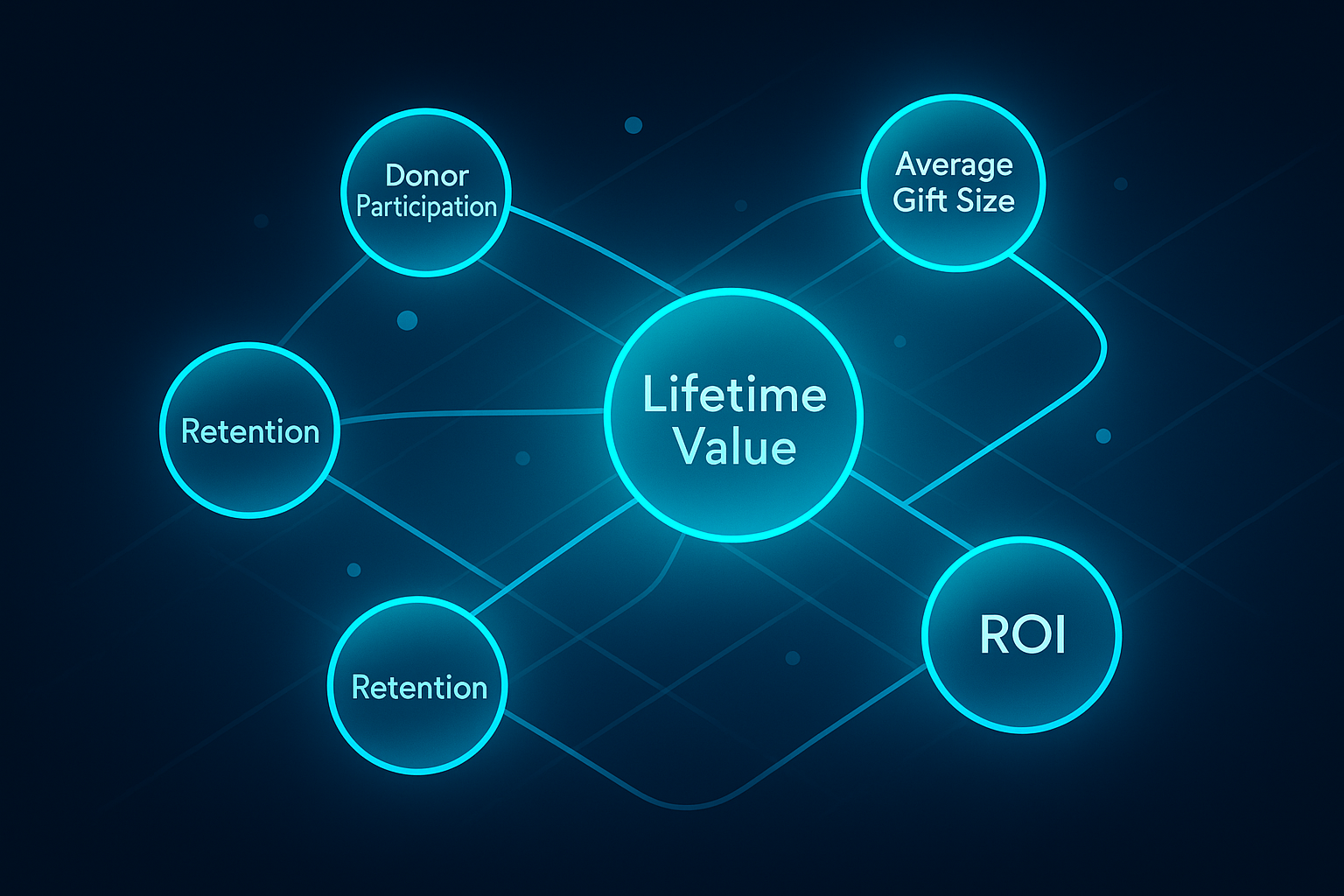
Effective annual fundraising measurement extends beyond total dollars raised. Modern organizations track five critical KPIs: donor participation rate (percentage of constituents who give), average gift size, donor retention rate, donor lifetime value, and campaign ROI. These metrics reveal campaign health and predict future sustainability.
AI-powered dashboards enable real-time optimization during campaigns. Organizations can set automated alerts when participation drops below benchmarks or when specific segments underperform. For hospitality managers, this means tracking guest donation rates alongside satisfaction scores. Real estate agencies monitor client contribution patterns relative to transaction values. Recruitment firms measure candidate and client participation rates as relationship health indicators.
Critical Success Metrics by Industry:
• Hospitality: 15-25% guest participation, $75-150 average gift, 65% retention
• Real Estate: 20-30% client participation, $200-500 average gift, 70% retention
• Recruitment: 25-35% client participation, $150-300 average gift, 75% retention
• Fundraising: 35-45% donor participation, $100-250 average gift, 80% retention
Automated reporting systems should segment performance by acquisition channel, gift size, and donor history. This granular view reveals which strategies drive sustainable growth versus one-time spikes. Organizations using AI-enhanced analytics report 30-40% improvement in campaign optimization speed compared to manual analysis. For a deeper dive into how data and AI are transforming donor engagement, see this research on data-driven fundraising.
Stewardship and Donor Retention, Making Every Gift Count
Donor retention directly impacts annual fundraising ROI, retaining existing supporters costs 5-7 times less than acquiring new ones. Effective stewardship begins within 48 hours of gift receipt with personalized acknowledgment that references specific donor motivations and previous engagement history.
Automated stewardship sequences should include: immediate thank-you (personalized by gift level), impact update within 30 days, quarterly progress reports, and anniversary recognition. For hospitality businesses, this mirrors guest loyalty programs, acknowledging contributions while reinforcing positive experiences. Real estate agencies can parallel this with client appreciation campaigns that maintain relationships beyond transactions.
AI automation excels at stewardship timing and personalization. Systems can trigger specific messages based on donor behavior: lapsed donor re-engagement after 18 months, upgrade solicitations for consistent givers, or special recognition for milestone supporters. Organizations report 25-35% improvement in donor retention when implementing automated stewardship workflows.
Mid-level donor stewardship (gifts of $500-$5,000) requires particular attention, these supporters often become major donors but receive less personal attention than warranted. Automated systems can flag donors showing upgrade potential based on giving patterns, engagement scores, and demographic indicators. For more strategies on donor retention and stewardship, check out our upcoming blog post on maximizing donor lifetime value.
Overcoming Common Annual Fundraising Challenges, Practical Solutions
Donor fatigue represents the most significant challenge in modern annual fundraising. Organizations combat this through strategic communication timing, varied messaging approaches, and clear impact demonstration. The solution lies in treating fundraising as relationship building rather than transaction processing.
Low response rates typically indicate messaging misalignment or audience segmentation issues. AI-powered A/B testing can optimize subject lines, send times, and content formats within days rather than months. Hospitality managers apply similar principles when optimizing guest communication, testing reservation confirmations, upgrade offers, and satisfaction surveys for maximum engagement.
| Challenge | Root Cause | AI-Powered Solution | Expected Improvement |
|---|---|---|---|
| Donor Fatigue | Over-communication | Automated frequency optimization | 20-30% engagement increase |
| Low Response Rates | Poor segmentation | Predictive audience modeling | 35-45% response improvement |
| Message Staleness | Generic content | Dynamic personalization | 25-40% conversion boost |
| Channel Dependency | Single-channel focus | Omnichannel orchestration | 50-70% reach expansion |
Over-reliance on single communication channels limits campaign reach and effectiveness. Successful organizations deploy omnichannel strategies, coordinating direct mail, email, phone, and digital touchpoints. AI systems can determine optimal channel mix for each donor segment, similar to how hospitality businesses optimize guest communication across reservation systems, mobile apps, and in-person interactions. For more on the role of AI in business, see this overview of artificial intelligence in business.
Donor Pyramid and Contribution Structure, Maximizing Participation and Gift Size

The donor pyramid provides strategic framework for annual fundraising growth: broad base of small gifts (80% of donors, 20% of revenue), substantial middle tier (15% of donors, 30% of revenue), and major gift apex (5% of donors, 50% of revenue). This structure mirrors customer value pyramids in hospitality and real estate, most clients provide moderate value while top-tier relationships drive disproportionate revenue.
AI-powered propensity scoring identifies donors ready for pyramid advancement. Systems analyze giving history, engagement patterns, demographic data, and external indicators to predict upgrade likelihood. This approach parallels hospitality guest scoring, identifying visitors likely to book premium services or become repeat customers.
Pyramid movement strategies vary by level. Base-level donors receive consistent engagement and small upgrade asks ($25 to $50). Mid-level supporters get personalized attention and strategic solicitations ($100 to $500). Major donor prospects require individual cultivation and significant asks ($1,000+). Automation handles base and mid-level progression while flagging major donor opportunities for personal attention.
Organizations should expect 10-15% annual pyramid advancement when using systematic upgrade strategies. Real estate agencies applying similar principles report comparable success rates in client value progression, moving buyers from starter properties to luxury markets or converting one-time sellers into repeat investors. To learn more about our approach, visit our About page or contact us for a consultation.
The Future of Annual Fundraising, AI, Engagement, and Competitive Edge
The evolution of annual fundraising centers on predictive intelligence and hyper-personalization. AI systems will anticipate donor preferences, optimal ask amounts, and ideal communication timing with unprecedented accuracy. This transformation mirrors broader service industry trends, hospitality businesses already use AI for dynamic pricing, personalized recommendations, and predictive guest services.
Conversational AI represents the next frontier in donor engagement. Chatbots can handle routine inquiries, process gifts, and provide instant impact updates while escalating complex interactions to human staff. This technology particularly benefits smaller organizations lacking dedicated fundraising staff, similar to how AI customer service tools empower boutique hospitality businesses to deliver personalized guest experiences at scale. As AI becomes more accessible, mid-market organizations across real estate, recruitment, fundraising, and hospitality will gain a competitive edge by combining automation with authentic human connection.
Frequently Asked Questions
What distinguishes annual fundraising from capital campaigns and endowment funds in terms of purpose and fund usage?
Annual fundraising focuses on securing recurring, unrestricted donations to support a nonprofit’s day-to-day operating expenses throughout the year. In contrast, capital campaigns target restricted funds for major projects over several years, while endowment funds provide long-term financial stability through investment income.
How do AI-powered strategies enhance donor engagement and retention in annual fundraising?
AI-powered strategies improve donor engagement by enabling smart segmentation, personalized multi-channel appeals, and predictive analytics that anticipate donor behavior. This targeted approach increases retention rates and maximizes the return on investment by delivering relevant, timely communications that resonate with individual donors.
Why is unrestricted revenue from annual fundraising critical for nonprofit operational flexibility?
Unrestricted revenue from annual fundraising allows nonprofits to allocate funds where they are most needed, enabling rapid responses to emerging challenges or opportunities. This financial flexibility supports ongoing program delivery and operational stability without the constraints of donor-imposed restrictions.
What are the key benefits of maintaining a robust annual fundraising program for a nonprofit’s financial health and mission delivery?
A strong annual fundraising program ensures consistent cash flow to cover operating costs, reduces reliance on unpredictable funding sources, and fosters long-term donor relationships. This stability enhances mission delivery by providing the resources needed to sustain and scale programs effectively throughout the year.
About The Author
Anas Moujahid is the chief contributing writer & Operations Director for the Vynta Blog, where he turns cutting-edge AI automation into measurable business outcomes for mid-market companies.
Vynta designs enterprise-grade AI agents that augment rather than replace people, freeing teams to focus on higher-value work while the bots handle the busywork.
We specialise in four service-heavy verticals where AI can move the revenue needle fast: real estate, recruitment, fundraising and hospitality.
Anas started his career architecting AI and automation systems; today he leads operations at Vynta, making sure every deployment lands real-world ROI, whether that’s more booked viewings for estate agents, faster placements for recruiters, warmer investor pipelines for fundraisers or happier guests for hotels and restaurants.
Vynta delivers results by:
- Building industry-specific agents pre-trained on real-world workflows, no generic chatbots here.
- Integrating seamlessly with existing CRMs, ATSs, PMSs and fundraising platforms, zero rip-and-replace.
- Measuring success in business KPIs (lead-to-close rates, time-to-hire, donor retention, RevPAR) not vanity metrics.
- Providing transparent implementation plans so clients know exactly what to expect, when and why.
- Pairing every AI agent with human-in-the-loop controls to keep quality, compliance and brand voice on point.
Since launch, Vynta has helped agencies slash lead qualification time by up to 70 %, recruitment firms cut screening hours in half, fundraising teams triple investor touchpoints and hospitality brands lift guest satisfaction scores by double digits, all while keeping human expertise firmly in the loop.
Anas writes with the same ethos that drives Vynta: outcome-focused, jargon-free and grounded in real business value. Expect data-backed insights, practical implementation guides and a clear-eyed view of what AI can, and can’t, do for your organisation.