

Key Takeaways
- Customer success key performance indicators help businesses shift from reactive problem-solving to proactive revenue generation.
- Most SMEs only track basic metrics such as customer complaints or revenue.
- Thriving companies measure predictive metrics like guest satisfaction scores to forecast repeat business.
- Engagement rates and interaction patterns can indicate future success in candidate placements and donor contributions.
Table of Contents
- What Are Customer Success Key Performance Indicators?
- Why Tracking Customer Success KPIs Drives Business ROI
- Core Categories of Customer Success KPIs
- The 10 Most Impactful Customer Success KPIs
- Comparing Core Customer Success Metrics: When to Use NPS vs CSAT vs CES
- How to Define and Implement Customer Success KPIs in Your Organization
- How to Measure, Calculate, and Visualize Customer Success KPIs
- Aligning Customer Success KPIs to the Customer Journey
- Driving Action With Customer Success KPIs: Best Practices for Impact
- Tools and Technology for Managing Customer Success KPIs at Scale
- Overcoming Common Implementation Challenges
Customer Success Key Performance Indicators: A Guide for SMEs
Customer success key performance indicators transform service-driven businesses from reactive problem-solvers into proactive revenue generators. While most SMEs track basic metrics like customer complaints or revenue, the companies that thrive measure what predicts success before it happens, guest satisfaction scores that forecast repeat bookings, candidate engagement rates that predict placement success, or donor interaction patterns that signal major gift potential.
The difference between tracking activity and tracking outcomes determines whether your hospitality business anticipates guest needs, your recruitment firm places top talent faster, or your fundraising organization builds lasting donor relationships. This guide reveals which customer success key performance indicators drive measurable business growth across service industries.
What Are Customer Success Key Performance Indicators?
Customer success KPIs measure the health, growth, and outcomes of customer relationships rather than just service delivery. Unlike traditional customer support metrics that track reactive responses, tickets resolved, call times, complaint resolution, customer success key performance indicators predict future behavior and revenue potential.
The fundamental distinction lies in timing and focus. Customer support KPIs measure what happened after problems occurred, while customer success metrics identify opportunities before they’re missed. A hotel tracking only complaint resolution misses the guest satisfaction patterns that predict repeat visits and referrals.
| Customer Success KPIs | Customer Support KPIs |
|---|---|
| Net Promoter Score (NPS) | Average Resolution Time |
| Customer Lifetime Value | First Call Resolution Rate |
| Product Adoption Rate | Ticket Volume |
| Expansion Revenue | Customer Effort Score |
For service-driven businesses, this translates into measuring guest upgrade acceptance rates rather than just booking confirmations, tracking candidate interview-to-offer ratios instead of just application volumes, or monitoring donor engagement trends rather than just donation amounts. These forward-looking metrics enable proactive interventions that drive revenue growth.
Why Tracking Customer Success KPIs Drives Business ROI

Businesses that systematically track customer success key performance indicators achieve 23% higher revenue growth and 18% better customer retention compared to those relying on traditional metrics alone. The ROI stems from shifting resources from reactive problem-solving to proactive opportunity creation.
Consider a boutique hotel that implemented guest satisfaction scoring across the entire stay journey. By tracking satisfaction at check-in, during service interactions, and pre-checkout, they identified that guests rating their first-day experience below 8/10 were 67% less likely to book future stays. This insight enabled immediate interventions, room upgrades, personalized concierge attention, dining recommendations, that increased repeat bookings by 31% within six months.
Revenue Impact Across Industries
- Hospitality: Guest health scoring reduces no-shows by 15-25% and increases upselling success by 40%
- Real Estate: Lead quality scoring improves conversion rates by 35% while reducing agent time per lead by 22%
- Recruitment: Candidate engagement tracking increases placement rates by 28% and reduces time-to-hire by 19%
The compounding effect occurs when these metrics inform automated workflows. AI-powered systems can trigger immediate interventions when KPIs indicate risk, sending personalized offers to guests showing low satisfaction, prioritizing high-engagement candidates for premium roles, or scheduling follow-up calls with donors showing decreased interaction patterns. This automation scales human expertise rather than replacing it.
Core Categories of Customer Success KPIs
Customer success key performance indicators fall into two essential categories that work together to drive sustainable growth: customer-centric metrics that measure experience quality, and business-centric metrics that track financial outcomes.
Customer-centric KPIs focus on satisfaction, engagement, and perceived value. Net Promoter Score measures advocacy likelihood, Customer Satisfaction Score tracks immediate experience quality, and Customer Effort Score evaluates interaction ease. These metrics predict future behavior, high NPS scores typically correlate with increased referrals and repeat business.
Business-centric KPIs measure financial health and operational efficiency. Customer Lifetime Value quantifies long-term revenue potential, churn rate indicates retention success, and expansion revenue tracks growth within existing relationships. These metrics directly connect customer success activities to bottom-line results.
| Industry | Customer-Centric KPIs | Business-Centric KPIs |
|---|---|---|
| Hospitality | Guest satisfaction score, service quality rating, amenity usage rate | Revenue per guest, repeat booking rate, upselling conversion |
| Real Estate | Client communication score, property match satisfaction, process transparency rating | Commission per client, referral generation rate, time-to-close |
| Recruitment | Candidate experience score, interview satisfaction, placement fit rating | Revenue per placement, client retention rate, time-to-fill |
The most successful service businesses track both categories simultaneously, using customer-centric metrics to identify improvement opportunities and business-centric metrics to measure impact. A recruitment firm might notice declining candidate experience scores (customer-centric) and correlate this with decreased placement rates (business-centric), enabling targeted process improvements that address both metrics.
The 10 Most Impactful Customer Success KPIs
Net Promoter Score (NPS)
Calculation: % Promoters (9-10 ratings) minus % Detractors (0-6 ratings). Review frequency: Monthly for trends, quarterly for strategic decisions. NPS predicts organic growth through referrals, particularly powerful in hospitality and real estate where word-of-mouth drives significant business.
Customer Lifetime Value (CLV)
Calculation: (Average purchase value × Purchase frequency × Gross margin) × Average customer lifespan. Review frequency: Quarterly. CLV measures the total revenue a customer generates throughout their relationship with your business. For hospitality businesses, this includes room bookings, dining, spa services, and repeat visits. Real estate agencies calculate CLV based on transaction commissions and referral value over time.
Industry application: A boutique hotel tracking CLV might discover that guests who book spa services have 40% higher lifetime value, informing targeted upselling strategies during check-in.
Customer Health Score
Calculation: Weighted composite of engagement metrics, satisfaction scores, and usage patterns. Review frequency: Weekly or real-time. Health scores predict churn risk before it becomes visible in traditional metrics.
Industry application: Recruitment firms use health scores combining client communication frequency, job posting activity, and payment history to identify at-risk accounts needing immediate attention.
Customer Effort Score (CES)
Calculation: Survey asking “How easy was it to resolve your issue?” on a 1-7 scale. Review frequency: After each service interaction. CES strongly correlates with customer loyalty and repeat business.
Industry application: Fundraising organizations use CES to measure donor experience during pledge processes, with scores below 5 triggering immediate follow-up to prevent donation abandonment.
Time to First Value (TTFV)
Calculation: Days/hours from initial engagement to first meaningful outcome. Review frequency: Monthly cohort analysis. Faster TTFV directly impacts customer satisfaction and retention rates.
Industry application: Real estate agencies measure TTFV as time from lead inquiry to first property viewing, optimizing response protocols to reduce this metric from days to hours.
Expansion Revenue Rate
Calculation: (Upsell + Cross-sell revenue ÷ Total existing customer revenue) × 100. Review frequency: Quarterly. This metric reveals your ability to grow revenue from existing relationships.
Industry application: Hotels track expansion revenue through room upgrades, extended stays, and additional services, with AI automation identifying optimal upselling moments based on guest behavior patterns.
Comparing Core Customer Success Metrics: When to Use NPS vs CSAT vs CES
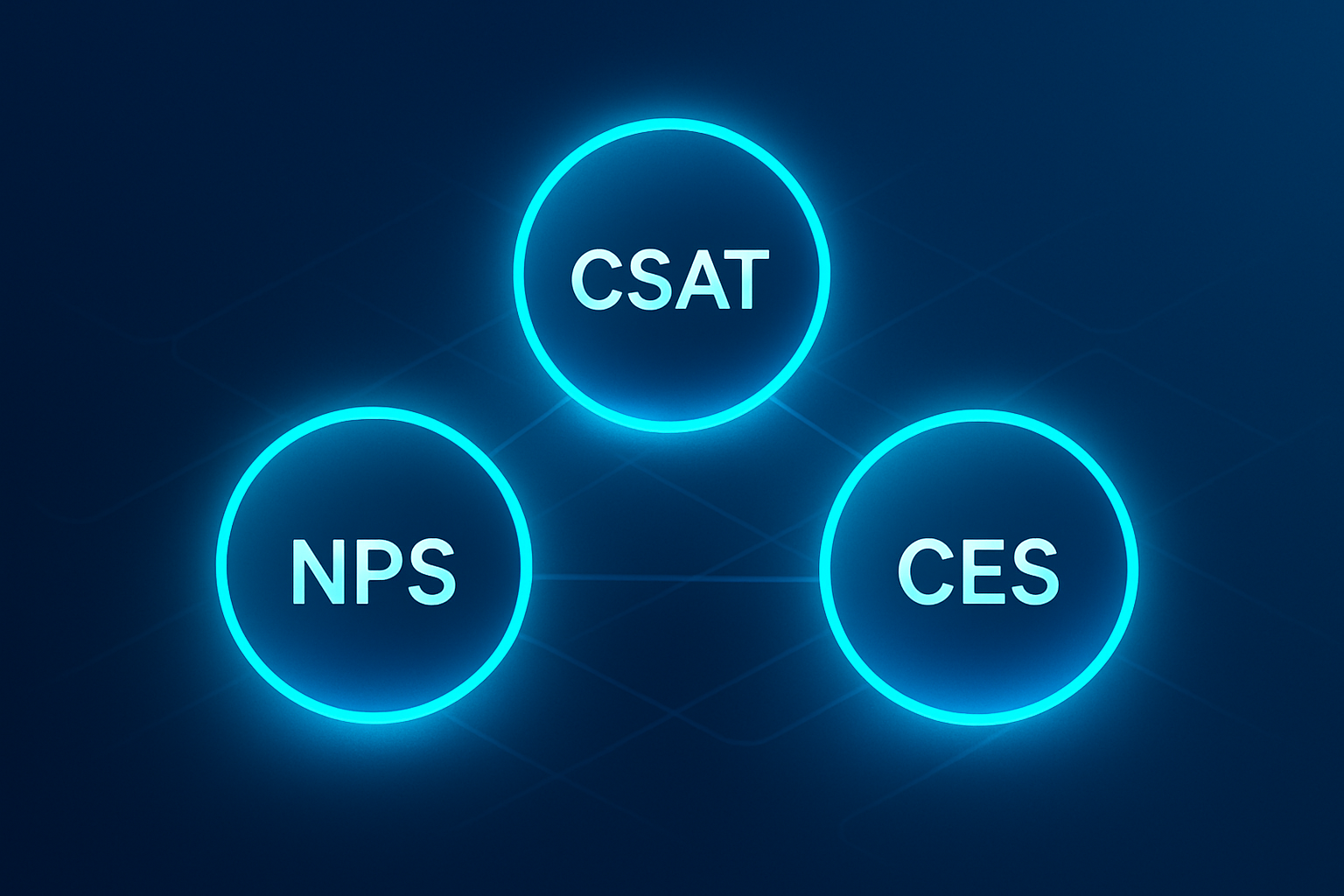
Understanding when to deploy specific customer success key performance indicators requires recognizing what each metric actually measures and their optimal use cases. While NPS, CSAT, and CES all gauge customer sentiment, they capture different aspects of the customer experience at distinct journey stages.
| Metric | What It Measures | Best Timing | Question Type | Actionable Insights |
|---|---|---|---|---|
| Net Promoter Score (NPS) | Likelihood to recommend | Post-service completion | 0-10 recommendation scale | Brand advocacy and referral potential |
| Customer Satisfaction (CSAT) | Satisfaction with specific interaction | Immediately after service | 1-5 satisfaction rating | Service quality and immediate improvements |
| Customer Effort Score (CES) | Ease of completing task | After problem resolution | 1-7 effort difficulty scale | Process optimization and friction removal |
| Customer Health Score | Overall relationship strength | Continuous monitoring | Composite data analysis | Churn prediction and proactive intervention |
Strategic application: A hospitality manager might use CSAT for check-in experience feedback, CES for reservation booking ease, NPS for overall stay recommendation likelihood, and health scores for identifying VIP guests requiring personalized attention. Each metric serves a distinct purpose in the customer success ecosystem.
Customer Health Scores differ fundamentally from satisfaction metrics by incorporating behavioral data alongside sentiment. While satisfaction scores capture momentary feelings, health scores predict future actions through engagement patterns, usage frequency, and relationship depth indicators.
How to Define and Implement Customer Success KPIs in Your Organization
Successful KPI implementation begins with aligning metrics to specific business objectives rather than tracking vanity numbers. Start by identifying your organization’s primary customer success goals: retention improvement, revenue expansion, operational efficiency, or service quality enhancement.
5-Step KPI Implementation Checklist
- Week 1: Conduct cross-functional alignment workshop with sales, operations, and customer teams
- Week 2: Define 3-5 core KPIs with specific calculation methods and target benchmarks
- Week 3: Establish data collection processes and assign metric ownership
- Week 4: Deploy measurement tools and create dashboard templates
- Week 6: Launch pilot program with weekly review cadence
Cross-team alignment ensures consistent KPI definitions across departments. Sales teams measuring “customer satisfaction” differently than operations creates conflicting data and misaligned actions. Establish shared definitions, calculation methods, and reporting standards before launching measurement initiatives.
Implementation requirements vary by industry vertical. Hospitality businesses need integration between property management systems, point-of-sale platforms, and guest feedback tools. Real estate agencies require CRM connectivity with lead generation sources and transaction management systems. Recruitment firms must connect applicant tracking systems with client communication platforms.
Technology infrastructure should support automated data collection wherever possible. Manual KPI tracking creates inconsistency and reduces measurement frequency. Modern customer success platforms can integrate multiple data sources, calculate composite scores automatically, and trigger alerts when metrics fall below acceptable thresholds.
How to Measure, Calculate, and Visualize Customer Success KPIs
Effective KPI measurement requires connecting disparate data sources into unified dashboards that provide actionable insights. Most customer success key performance indicators draw from multiple systems: CRM platforms, communication tools, financial systems, and direct customer feedback channels.
Data source mapping: NPS and CSAT scores come from survey platforms integrated with email and SMS systems. CLV calculations require financial data from billing systems combined with customer interaction history. Health scores aggregate engagement data from website analytics, support tickets, communication frequency, and more.
Aligning Customer Success KPIs to the Customer Journey

Effective customer success key performance indicators must map directly to specific stages in your customer journey. Tracking the wrong metric at the wrong time creates blind spots that allow revenue opportunities to slip through unnoticed.
In hospitality, measuring overall satisfaction without capturing check-in experience separately masks friction that drives immediate negative reviews. Real estate agencies tracking only final transaction satisfaction miss early warning signs during property search phases. Recruitment firms focusing solely on placement rates overlook candidate engagement drops that predict offer rejections.
Journey Stage Mapping Framework
- Acquisition: First impression metrics (initial response time, inquiry conversion rate)
- Onboarding: Time to first value, setup completion rate, early satisfaction scores
- Activation: Feature adoption, engagement frequency, milestone achievement
- Retention: Usage consistency, support ticket trends, renewal probability
- Expansion: Upsell acceptance, additional service adoption, referral generation
Boutique hotels should track guest effort scores during check-in, satisfaction ratings after first-night stay, and service utilization rates throughout the visit. Real estate agencies benefit from measuring property viewing conversion rates, communication responsiveness scores, and decision timeline adherence. Recruitment firms need candidate engagement metrics during initial screening, interview satisfaction scores, and offer acceptance predictors.
The key insight: stage-specific KPIs enable proactive intervention before issues compound across the entire customer relationship.
Driving Action With Customer Success KPIs: Best Practices for Impact
Measuring customer success key performance indicators without systematic action protocols transforms valuable data into meaningless dashboards. The gap between measurement and improvement closes through automated triggers, structured review processes, and human-AI collaboration.
Implement threshold-based alerts that prompt immediate intervention. When guest satisfaction drops below 7/10, hotel staff receive automated notifications within two hours, enabling same-day service recovery. Real estate agents get instant alerts when client communication gaps exceed 48 hours, preventing relationship deterioration. Recruitment consultants receive candidate engagement warnings before interview scheduling conflicts arise.
Proven Action Frameworks
Rapid Response Protocols: Define specific actions for each KPI threshold breach. CSAT scores below 80% trigger manager involvement within four hours. Customer health scores dropping 20% activate account review meetings within 24 hours.
Predictive Intervention: Use trend analysis to prevent issues before they impact KPIs. Declining engagement patterns predict churn risk three weeks before actual departure, allowing proactive retention efforts.
Cross-Team Coordination: Align KPI ownership across departments. Sales teams monitor acquisition metrics, operations track activation rates, and customer success focuses on retention indicators.
Fundraising organizations using this approach see 23% higher donor retention through automated appreciation sequences triggered by engagement score improvements. Hospitality businesses reduce negative review rates by 34% through real-time satisfaction monitoring and immediate service adjustments.
Tools and Technology for Managing Customer Success KPIs at Scale
Selecting the right technology stack determines whether your customer success key performance indicators drive meaningful business outcomes or become administrative overhead. Industry-specific solutions outperform generic platforms by integrating seamlessly with existing workflows and providing contextually relevant insights—see andrew olsen for a perspective on aligning tools with outcomes.
| Platform Type | Best For | Integration Strength | Automation Capabilities | Industry Focus |
|---|---|---|---|---|
| Vynta | Mid-market SMEs across hospitality, real estate, recruitment, fundraising | Native CRM, PMS, ATS integration | Predictive analytics, automated workflows | Industry-specific templates |
| Gainsight | Enterprise SaaS companies | Salesforce-centric | Rules-based automation | Technology sector |
| ChurnZero | B2B subscription businesses | Limited PMS/ATS support | Basic trigger campaigns | Software/SaaS |
| Totango | Product-led growth companies | API-dependent | Segment-based automation | Digital products |
Hospitality managers need platforms that connect reservation systems, guest communication channels, and service delivery tracking. Real estate agencies require integration between CRM, listing platforms, and transaction management tools. Recruitment firms benefit from ATS connectivity, candidate communication tracking, and placement pipeline visibility.
Real estate agencies benefit from industry-tailored automation that enhances human decision-making rather than replacing relationship management. The platform aggregates data from hospitality property management systems, real estate CRMs, recruitment applicant tracking systems, and fundraising donor databases into unified KPI dashboards.
Selection Criteria for Maximum Impact
Choose platforms offering real-time data synchronization, customizable alert thresholds, and workflow automation that matches your industry’s customer interaction patterns. Avoid solutions requiring extensive technical implementation or forcing generic KPI frameworks onto specialized business models.
Overcoming Common Implementation Challenges

Most customer success KPI initiatives fail due to predictable obstacles that derail measurement programs before they generate actionable insights. Data fragmentation, metric overload, and change resistance create barriers that proper planning and phased implementation can eliminate.
Data Silos and Integration Complexity
Service-based businesses often struggle with customer data scattered across reservation systems, communication platforms, billing software, and feedback tools. Hotels track guest preferences in PMS while satisfaction surveys live in separate systems. Real estate agencies maintain client information in CRM but property interactions in listing platforms.
Solution: Start with one integrated data source and expand gradually. Begin KPI tracking within your primary customer system (CRM, PMS, or ATS) before attempting cross-platform integration. This approach delivers immediate value while building technical capability.
Quick Implementation Fixes
- Dashboard Fatigue: Limit initial KPI tracking to three core metrics per role
- Inconsistent Definitions: Create shared KPI glossaries with calculation examples
- Action Paralysis: Define specific response protocols for each metric
For further reading on SME management control systems and KPI implementation, see this mixed-methods study on SME managers’ perceptions. Additionally, you can explore fundraising solutions tailored for service-driven organizations.
Frequently Asked Questions
What are the key differences between customer success KPIs and traditional customer support metrics?
Customer success KPIs focus on measuring the health and growth of customer relationships by predicting future behavior and revenue potential, whereas traditional customer support metrics track reactive responses like ticket resolution and complaint handling. The key difference lies in timing and focus: customer success KPIs are proactive and outcome-driven, while support metrics are reactive and service-oriented.
Which predictive customer success KPIs should SMEs focus on to forecast repeat business and revenue growth?
SMEs should prioritize predictive KPIs such as guest satisfaction scores, engagement rates, and interaction patterns. These metrics help forecast repeat bookings in hospitality, successful candidate placements in recruitment, and donor contributions in fundraising, enabling businesses to anticipate customer needs and drive proactive revenue growth.
How can businesses effectively implement and align customer success KPIs throughout the customer journey?
Businesses should define KPIs that map directly to key stages of the customer journey, ensuring metrics reflect both engagement and satisfaction at each touchpoint. This alignment enables teams to identify opportunities for intervention, optimize experiences, and drive measurable outcomes by connecting data insights with actionable strategies across sales, service, and retention.
What tools and best practices can help organizations overcome challenges in managing customer success KPIs at scale?
Organizations benefit from using integrated CRM and analytics platforms tailored to their industry vertical, combined with clear data governance and regular performance reviews. Best practices include setting realistic KPI targets, fostering cross-functional collaboration, and maintaining transparency about AI capabilities to ensure KPIs drive strategic decision-making without overwhelming teams.
About The Author
Anas Moujahid is the chief contributing writer & Operations Director for the Vynta Blog, where he turns cutting-edge AI automation into measurable business outcomes for mid-market companies.
Vynta designs enterprise-grade AI agents that augment rather than replace people, freeing teams to focus on higher-value work while the bots handle the busywork.
We specialise in four service-heavy verticals where AI can move the revenue needle fast: real estate, recruitment, fundraising and hospitality.
Anas started his career architecting AI and automation systems; today he leads operations at Vynta, making sure every deployment lands real-world ROI, whether that’s more booked viewings for estate agents, faster placements for recruiters, warmer investor pipelines for fundraisers or happier guests for hotels and restaurants.
Vynta delivers results by:
- Building industry-specific agents pre-trained on real-world workflows, no generic chatbots here.
- Integrating seamlessly with existing CRMs, ATSs, PMSs and fundraising platforms, zero rip-and-replace.
- Measuring success in business KPIs (lead-to-close rates, time-to-hire, donor retention, RevPAR) not vanity metrics.
- Providing transparent implementation plans so clients know exactly what to expect, when and why.
- Pairing every AI agent with human-in-the-loop controls to keep quality, compliance and brand voice on point.
Since launch, Vynta has helped agencies slash lead qualification time by up to 70 %, recruitment firms cut screening hours in half, fundraising teams triple investor touchpoints and hospitality brands lift guest satisfaction scores by double digits, all while keeping human expertise firmly in the loop.
Anas writes with the same ethos that drives Vynta: outcome-focused, jargon-free and grounded in real business value. Expect data-backed insights, practical implementation guides and a clear-eyed view of what AI can, and can’t, do for your organisation.