

Table of Contents
- Advertising in Management: Complete AI-Powered Guide
- Advertising Management: Strategic Foundations
- Types of Advertising: Choosing the Right Approach
- Building Future-Ready Advertising Strategies with AI
- Smart Budgeting and Resource Allocation
- Campaign Planning and Execution Excellence
- Advertising Management Tools and Platforms
- AI Automation in Advertising Management: Practical Implementation
- Measuring and Proving Advertising Effectiveness
- Advertising Management Platforms: Strategic Partner Analysis
- Overcoming Common Advertising Management Challenges
- Future Considerations in Advertising Management
ai-powered-transformation">Advertising in Management: Complete AI-Powered Guide
Modern advertising in management has evolved from creative guesswork to data-driven revenue generation. For mid-market SMEs across real estate, recruitment, fundraising, and hospitality, advertising management now serves as the primary engine for lead qualification, customer acquisition, and measurable business growth. The integration of AI automation transforms advertising from a cost center into a strategic advantage that scales human expertise while delivering consistent, trackable outcomes.
This comprehensive guide examines how intelligent advertising management drives measurable results across industry verticals, with specific focus on AI-powered solutions that augment rather than replace human creativity and strategic thinking.
Advertising Management: Strategic Foundations

Core Definition and Business Impact
Advertising management encompasses the strategic planning, execution, and optimization of paid promotional communications designed to generate specific business outcomes. Unlike general marketing activities, advertising management focuses on measurable, paid media investments that directly impact revenue metrics, lead conversion rates in real estate, placement success in recruitment, donor engagement in fundraising, and guest satisfaction scores in hospitality.
The American Marketing Association defines advertising as "paid, non-personal communication through various media by business firms, nonprofit organizations, and individuals who are identified in the advertising message and who hope to inform or persuade members of a particular audience." For mid-market SMEs, this translates to systematic investment in channels that deliver quantifiable returns on advertising spend.
Strategic Objectives and Core Functions
Effective advertising management serves four primary business objectives: building qualified awareness within target markets, generating and nurturing high-quality leads via leads acquisition, driving conversion actions that impact revenue, and enhancing customer lifetime value through retention and upselling. Each objective requires distinct measurement frameworks and optimization strategies.
Core functions include audience segmentation based on behavioral and demographic data, message development that resonates with sector-specific pain points, media planning that maximizes reach within budget constraints, and performance tracking that enables continuous optimization. AI automation enhances each function by processing larger datasets, identifying patterns human analysts might miss, and executing optimizations at scale.
Types of Advertising: Choosing the Right Approach
Brand Building vs. Direct Response Strategies
Brand advertising focuses on long-term awareness and perception, building trust and recognition that supports future conversion activities. Direct response advertising prioritizes immediate, measurable actions, form submissions, phone calls, bookings, or purchases. Most successful mid-market campaigns blend both approaches, using brand elements to enhance direct response effectiveness.
Real estate agencies benefit from brand advertising that establishes market authority while running direct response campaigns for specific property listings. Recruitment firms use brand advertising to attract both candidates and clients while deploying direct response tactics for urgent placement needs. The key lies in balancing immediate revenue needs with sustainable market positioning.
Specialized Advertising for Key Verticals
Each industry vertical requires tailored advertising approaches that address unique buyer journeys and decision-making processes. Real estate advertising must navigate emotional and financial complexity, often requiring multiple touchpoints before conversion. Recruitment advertising targets both active and passive candidates while simultaneously appealing to hiring managers.
Fundraising organizations face distinct challenges in donor acquisition and retention, requiring advertising that builds emotional connection while demonstrating impact. Hospitality advertising focuses on experience differentiation and seasonal optimization, balancing direct bookings with reputation management across review platforms.
Building Future-Ready Advertising Strategies with AI
Strategic Planning and Implementation Framework
Modern advertising strategy begins with comprehensive business objective alignment, ensuring every advertising dollar supports measurable outcomes. This requires analyzing current market position, identifying high-value customer segments, and mapping advertising activities to specific business KPIs, whether property sales velocity, candidate placement rates, fundraising targets, or guest satisfaction metrics.
AI automation enhances strategic planning by analyzing historical performance data, identifying optimal audience segments, and predicting campaign outcomes based on market conditions. This data-driven approach eliminates guesswork while preserving human creativity and strategic insight.
Platform Selection and Channel Optimization
Effective channel selection balances audience reach, engagement quality, and cost efficiency across traditional and digital platforms. Traditional channels, television, radio, print, and outdoor advertising, offer broad reach and credibility but limited targeting precision. Digital channels provide granular targeting and real-time optimization but require sophisticated management to avoid ad fraud and ensure brand safety.
Digital Platform Advantages:
- Precise audience targeting based on demographics, behavior, and intent
- Real-time performance tracking and budget optimization
- A/B testing capabilities for creative and messaging refinement
- Integration with CRM systems for lead tracking and attribution
Digital Platform Challenges:
- Ad fraud and brand safety concerns requiring constant monitoring
- Platform algorithm changes that can impact campaign performance
- Increasing competition driving up cost-per-click across industries
- Technical complexity requiring specialized expertise or automation
The optimal approach combines channels based on customer journey stages, using awareness-building channels for top-funnel activities and conversion-focused platforms for bottom-funnel optimization.
Smart Budgeting and Resource Allocation
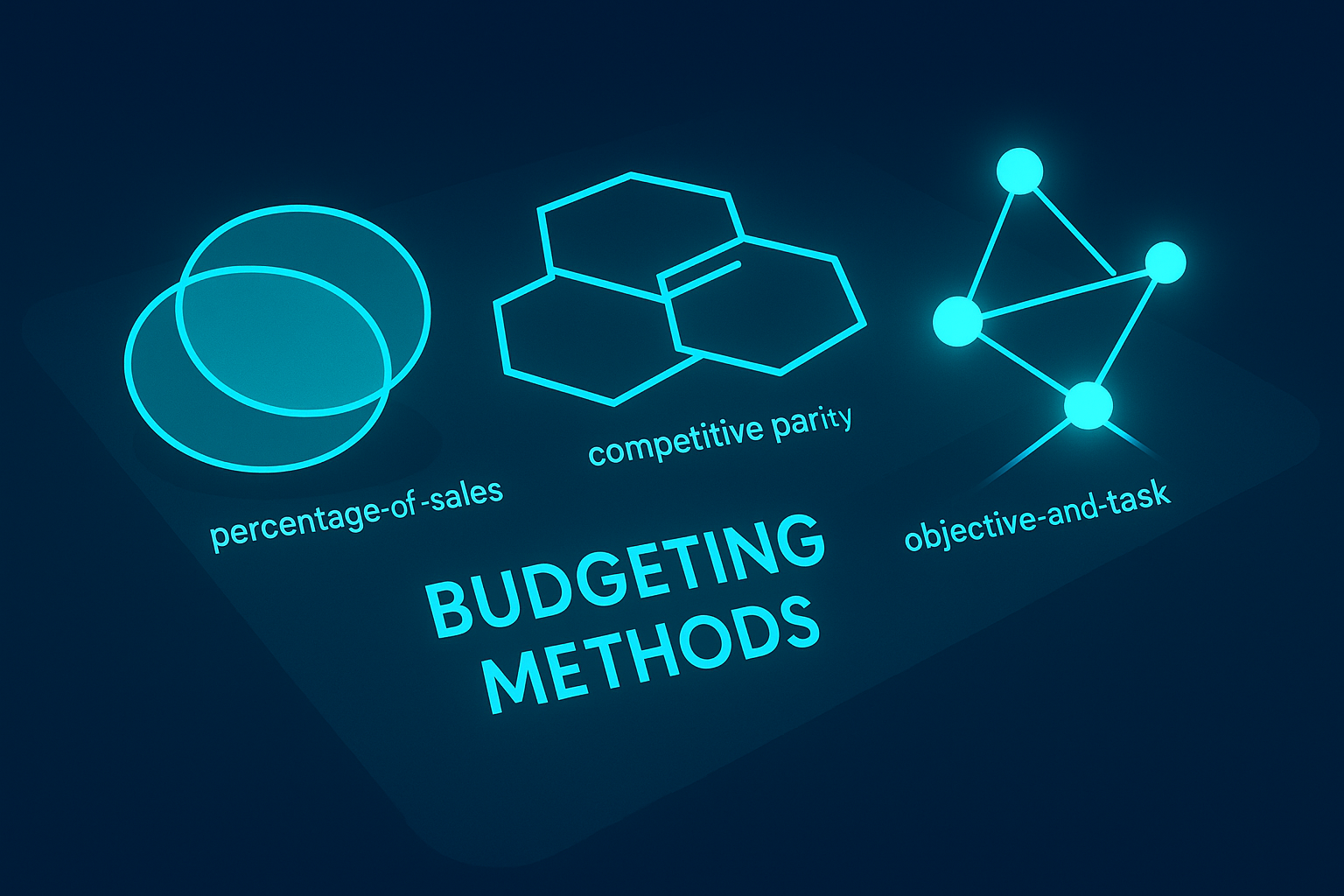
Evidence-Based Budgeting Methods
Traditional budgeting methods, percentage-of-sales, competitive parity, and objective-and-task, each offer distinct advantages depending on business maturity and market conditions. Percentage-of-sales provides predictable budgeting but may limit growth during market opportunities. Competitive parity ensures market presence but ignores unique business advantages or constraints.
The objective-and-task method, enhanced by AI forecasting, offers the most strategic approach for growth-focused SMEs. This method defines specific advertising objectives, identifies required activities to achieve those objectives, and calculates associated costs. AI automation improves accuracy by analyzing historical performance data and market conditions to predict required investment levels.
Maximizing Impact Through Strategic Resource Allocation
Effective resource allocation balances immediate revenue generation with long-term market positioning across the customer lifecycle. Typically, 40-50% of advertising budget should focus on new customer acquisition, 30-40% on customer retention and upselling, and 10-20% on brand building and market expansion activities.
AI-powered budget optimization continuously analyzes performance across channels and customer segments, automatically reallocating spend toward highest-performing activities. This dynamic approach maximizes return on advertising spend while maintaining strategic balance across business objectives.
Campaign Planning and Execution Excellence
End-to-End Campaign Management
Successful campaign execution follows a systematic lifecycle: strategic planning aligned with business objectives, creative development that resonates with target audiences, media planning that optimizes reach and frequency, campaign launch with proper tracking implementation, and ongoing optimization based on performance data.
Each phase requires specific expertise and tools.
Advertising Management Tools and Platforms
Modern advertising in management requires sophisticated platforms that can handle complex campaign orchestration, audience targeting, and performance tracking across multiple channels. The choice between generic advertising tools and industry-specific solutions directly impacts your ability to generate qualified leads, optimize conversion rates, and achieve measurable ROI in competitive markets.
Generic platforms like Google Ads Manager and Meta Business Suite offer broad reach but lack the nuanced understanding of industry-specific buyer journeys. For example, a real estate agency needs tools that understand property matching algorithms and lead qualification workflows, while recruitment firms require platforms that can optimize for candidate quality metrics rather than just click-through rates. This fundamental difference in approach determines whether your advertising investment drives genuine business outcomes or simply generates vanity metrics.
Digital Advertising Platforms: Capabilities and Limitations
Enterprise-grade advertising platforms provide centralized campaign management, automated bidding, and cross-channel attribution tracking. Google Ad Manager excels in search intent capture and display network reach, while Meta Business Suite dominates social engagement and lookalike audience targeting. However, these platforms operate on generic conversion models that don't account for industry-specific sales cycles or qualification criteria.
The critical limitation emerges in lead quality and attribution accuracy. A hospitality business using generic platforms might optimize for booking clicks rather than actual revenue per guest or guest satisfaction scores. Similarly, fundraising organizations often struggle with donor lifetime value optimization when platforms focus on immediate conversion metrics rather than long-term relationship building.
Industry-Specific Solutions: The Vynta Advantage
Vynta's approach to advertising management centers on industry-specific automation that understands unique business models and success metrics. Our platform integrates directly with CRM systems, property management software, applicant tracking systems, and guest management platforms to ensure advertising campaigns optimize for actual business outcomes rather than surface-level engagement metrics.
For real estate agencies, this means automated lead scoring based on property preferences, budget qualification, and buying timeline rather than just form submissions. Recruitment firms benefit from candidate quality algorithms that factor in skill matching, salary expectations, and cultural fit indicators. This industry-specific intelligence transforms advertising from a cost center into a predictable revenue driver with clear attribution to closed deals, successful placements, or donor conversions.
| Feature | Generic Platforms | Vynta Industry Solutions |
|---|---|---|
| Lead Qualification | Basic form completion tracking | Industry-specific scoring algorithms |
| Attribution Modeling | Last-click or simple multi-touch | Full sales cycle attribution to closed deals |
| Audience Targeting | Demographic and behavioral data | Industry buyer persona optimization |
| Campaign Automation | Bid management and basic rules | End-to-end workflow automation |
| Integration Depth | Limited API connections | Native CRM and industry system integration |
| Success Metrics | Clicks, impressions, basic conversions | Revenue, deal quality, customer lifetime value |
AI Automation in Advertising Management: Practical Implementation

AI automation transforms advertising management from reactive campaign adjustments to proactive optimization based on predictive analytics and real-time performance data. The key differentiator lies in how AI augments human strategic thinking rather than replacing it, enabling marketing teams to focus on creative strategy and relationship building while automation handles repetitive optimization tasks.
Successful AI implementation in advertising management requires understanding where automation adds genuine value versus where human judgment remains essential. Campaign creative development, brand messaging, and strategic positioning benefit from human insight, while bid optimization, audience segmentation, and performance monitoring achieve superior results through AI-powered automation.
Process Automation for Advertising Operations
Automated advertising operations eliminate manual bottlenecks that prevent rapid campaign scaling and optimization. Lead qualification workflows automatically score incoming prospects based on industry-specific criteria, routing high-value leads to sales teams within minutes rather than hours. Campaign performance monitoring identifies underperforming ad sets and automatically reallocates budget to higher-converting variations.
For hospitality businesses, this means automated seasonal campaign adjustments based on booking patterns and local events, plus real-time upselling message optimization based on guest preferences and stay duration. Recruitment agencies benefit from automated candidate sourcing campaigns that adjust messaging and targeting based on job market conditions and application quality metrics. These operational efficiencies compound over time, creating sustainable competitive advantages.
Human-AI Collaboration in Campaign Strategy
The most effective advertising management combines human creativity and strategic insight with AI-powered execution and optimization. Marketing teams develop campaign concepts, brand messaging, and strategic positioning while AI handles audience testing, bid optimization, and performance tracking across multiple channels simultaneously.
This collaboration model enables small marketing teams to compete with larger organizations by leveraging AI to amplify their strategic decisions. A boutique hotel manager can develop personalized guest experience campaigns while AI optimizes delivery timing, audience segments, and budget allocation across social media, search, and display channels. The result is sophisticated campaign management that would typically require dedicated specialists for each platform.
AI Automation Advantages
- 24/7 campaign optimization without manual intervention
- Real-time budget reallocation based on performance data
- Predictive audience targeting using historical conversion patterns
- Automated A/B testing across multiple campaign variables
- Integration with CRM systems for complete attribution tracking
Implementation Considerations
- Initial setup requires strategic planning and data integration
- Team training needed for effective human-AI collaboration
- Regular monitoring to ensure AI decisions align with business goals
- Industry-specific customization essential for optimal results
Measuring and Proving Advertising Effectiveness
Effective measurement in advertising management extends beyond traditional metrics like impressions and click-through rates to focus on business impact metrics that directly correlate with revenue growth and operational efficiency. The challenge for mid-market SMEs lies in establishing attribution models that accurately connect advertising spend to closed deals, successful placements, or long-term customer relationships. For further insights on how AI is shaping the future of marketing, see AI will shape the future of marketing.
Industry-specific measurement frameworks provide clearer insights into advertising ROI by tracking metrics that matter for each business model. Real estate agencies measure lead-to-closing ratios and average deal size, recruitment firms focus on time-to-hire and placement quality, fundraising organizations track donor retention and average gift size, and hospitality businesses monitor guest satisfaction scores and revenue per guest. By aligning advertising metrics with core business outcomes, organizations can demonstrate the true value of their advertising investments and make data-driven decisions for future campaigns.
Advertising Management Platforms: Strategic Partner Analysis
Selecting the right advertising in management platform requires evaluating both technical capabilities and industry-specific expertise. Mid-market SMEs need solutions that deliver measurable outcomes without requiring extensive internal AI resources.
Vynta - Industry-Specialized Automation
Best for: Real estate, recruitment, fundraising, and hospitality businesses seeking AI-powered advertising automation with measurable ROI.
Vynta's approach centers on industry-specific advertising workflows that integrate directly with existing CRM systems. Rather than generic campaign management, the platform automates lead qualification for real estate agencies, candidate sourcing campaigns for recruitment firms, investor outreach for fundraising organizations, and guest experience optimization for hospitality businesses.
Advantages:
- Pre-built workflows for four core verticals
- Direct CRM integration with automated lead scoring
- Human-AI collaboration framework
- Transparent implementation timeline
- Industry-specific compliance features
Limitations:
- Limited to four industry verticals
- Requires initial workflow customization
- Not suitable for enterprise-scale campaigns
Google Ad Manager - Comprehensive Digital Reach
Best for: Businesses prioritizing maximum digital reach across multiple channels and formats.
Google's platform excels in programmatic advertising and audience targeting across the entire Google ecosystem. The yield optimization features help maximize ad revenue, while brand safety controls protect campaign integrity across diverse placements.
Meta Business Suite - Social Media Engagement
Best for: Companies focusing on social media advertising and community building strategies.
Meta's integrated approach combines Facebook, Instagram, and WhatsApp advertising management. The platform's strength lies in detailed demographic targeting and creative testing capabilities, particularly effective for brand awareness campaigns.
HubSpot Marketing Hub - Inbound Integration
Best for: Organizations prioritizing inbound marketing integration with advertising campaigns.
HubSpot's unified approach connects advertising spend directly to lead nurturing workflows. The platform excels at attribution tracking and provides clear visibility into how advertising investments impact the entire customer journey. For a deeper dive into designing an AI marketing strategy, refer to How to Design an AI Marketing Strategy.
| Platform | Industry Focus | Automation Level | Implementation Time | Best Use Case |
|---|---|---|---|---|
| Vynta | 4 specialized verticals | Full workflow automation | 2-4 weeks | Mid-market SME growth |
| Google Ad Manager | Universal | Campaign optimization | 1-2 weeks | Maximum digital reach |
| Meta Business Suite | Universal | Creative testing | 1 week | Social media focus |
| HubSpot Marketing Hub | Universal | Lead nurturing | 3-6 weeks | Inbound marketing |
Overcoming Common Advertising Management Challenges

Traditional advertising management faces predictable obstacles that AI automation can systematically address. Understanding these challenges helps businesses implement more effective solutions.
Campaign Underperformance and Rapid Response
Campaign failures typically stem from four root causes: misaligned messaging, inappropriate channel selection, poor audience targeting, or creative fatigue. AI-powered anomaly detection identifies performance drops within hours rather than weeks, enabling immediate corrective action.
For real estate agencies, this might mean detecting when property listing ads generate clicks but no qualified leads, triggering automatic message optimization. Recruitment firms benefit from identifying when job postings attract applications but fail to convert quality candidates, prompting audience refinement.
Budget Optimization Under Resource Constraints
Mid-market businesses often struggle with limited advertising budgets and small marketing teams. Automation enables high-frequency experimentation that would be impossible manually. Instead of running one campaign per month, businesses can test multiple message variants, audience segments, and creative approaches simultaneously.
Hospitality managers can automatically test different guest experience messaging across various booking platforms, while fundraising organizations can personalize donor outreach at scale without additional staffing costs.
Regulatory Compliance and Brand Safety
Industry-specific regulations create complex compliance requirements that generic platforms often overlook. Real estate advertising must comply with fair housing laws, recruitment campaigns face employment regulations, and fundraising organizations navigate donor privacy requirements.
Specialized platforms build compliance directly into campaign workflows, automatically flagging potential issues before campaigns launch. This proactive approach prevents costly mistakes and protects brand reputation across all advertising channels.
Future Considerations in Advertising Management
The evolution of advertising in management reflects broader shifts toward personalization, automation, and measurable business outcomes. Three emerging trends will reshape how mid-market SMEs approach advertising strategy.
Predictive Campaign Optimization
Advanced AI models will predict campaign performance before launch, enabling businesses to allocate budgets more strategically. Rather than reactive optimization, predictive systems will recommend optimal messaging, timing, and channel mix based on historical patterns and market conditions.
This capability particularly benefits seasonal businesses in hospitality and cyclical industries like real estate, where timing significantly impacts campaign effectiveness.
Unified Cross-Platform Attribution
Future advertising management platforms will provide seamless attribution across all touchpoints, from initial awareness through final conversion. This comprehensive view enables more accurate ROI calculation and budget allocation decisions.
Recruitment agencies will track candidate journeys from job board impressions through successful placements, while fundraising organizations will connect donor touchpoints across multiple campaigns and events.
Deepening Industry Specialization
For recruitment firms seeking advanced automation, candidate sourcing campaigns can be streamlined and optimized for quality metrics and efficiency.
Frequently Asked Questions
What is advertising in management?
Advertising in management refers to the strategic planning, execution, and oversight of promotional activities aimed at communicating a business's value proposition to its target audience. It involves aligning advertising efforts with overall business objectives to drive customer engagement, brand awareness, and ultimately measurable revenue growth.
What do you do in advertising management?
In advertising management, you develop and coordinate advertising campaigns, select appropriate media channels, allocate budgets, monitor performance metrics, and optimize campaigns based on data-driven insights. The goal is to ensure that advertising investments deliver a strong return on investment (ROI) by effectively reaching and influencing the desired customer segments.
Is advertising a management function?
Yes, advertising is a critical management function because it involves planning, organizing, directing, and controlling promotional activities to support business goals. Effective advertising management ensures that marketing messages are strategically crafted and delivered to maximize impact, making it integral to overall business management and growth.
What are the 5 M's of advertising?
The 5 M's of advertising are Mission, Money, Message, Media, and Measurement. Mission defines the objective of the advertising campaign; Money refers to the budget allocated; Message is the content and creative idea conveyed; Media identifies the channels used to reach the audience; and Measurement involves assessing the campaign's effectiveness through key performance indicators.
What is the meaning of ad in management?
In management, 'ad' is short for advertisement, which is a planned communication designed to inform, persuade, or remind a target audience about a product, service, or brand. Managing 'ads' involves overseeing these communications to ensure they align with business strategies and generate desired customer responses—as is often the case for a rotational product manager coordinating cross-functional campaigns.
What is advertising in a business?
Advertising in a business context is the purposeful activity of promoting products or services to potential customers through paid channels. It aims to increase brand visibility, attract leads, support sales efforts, and enhance customer engagement, thereby contributing directly to business growth and profitability.
About The Author
Anas Moujahid is the chief contributing writer & Operations Director for the Vynta Blog, where he turns cutting-edge AI automation into measurable business outcomes for mid-market companies.
Vynta designs enterprise-grade AI agents that augment rather than replace people, freeing teams to focus on higher-value work while the bots handle the busywork.
We specialise in four service-heavy verticals where AI can move the revenue needle fast: real estate, recruitment, fundraising and hospitality.
Anas started his career architecting AI and automation systems; today he leads operations at Vynta, making sure every deployment lands real-world ROI, whether that’s more booked viewings for estate agents, faster placements for recruiters, warmer investor pipelines for fundraisers or happier guests for hotels and restaurants.
Vynta delivers results by:
- Building industry-specific agents pre-trained on real-world workflows, no generic chatbots here.
- Integrating seamlessly with existing CRMs, ATSs, PMSs and fundraising platforms, zero rip-and-replace.
- Measuring success in business KPIs (lead-to-close rates, time-to-hire, donor retention, RevPAR) not vanity metrics.
- Providing transparent implementation plans so clients know exactly what to expect, when and why.
- Pairing every AI agent with human-in-the-loop controls to keep quality, compliance and brand voice on point.
Since launch, Vynta has helped agencies slash lead qualification time by up to 70 %, recruitment firms cut screening hours in half, fundraising teams triple investor touchpoints and hospitality brands lift guest satisfaction scores by double digits, all while keeping human expertise firmly in the loop.
Anas writes with the same ethos that drives Vynta: outcome-focused, jargon-free and grounded in real business value. Expect data-backed insights, practical implementation guides and a clear-eyed view of what AI can, and can’t, do for your organisation.