

Key Takeaways
- Leads acquisition has advanced from basic contact capture to intelligent prospect qualification.
- Effective leads acquisition is crucial for sustainable growth in mid-market SMEs.
- Industries such as real estate, recruitment, fundraising, and hospitality benefit significantly from improved leads acquisition strategies.
- Modern leads acquisition techniques directly impact measurable business outcomes.
Table of Contents
- Leads Acquisition Playbook: AI-Powered SME Growth 2025
- Lead Generation vs. Acquisition: Strategic Distinctions
- Why Lead Acquisition Is Mission-Critical for 2025
- Building an Effective Lead Acquisition Strategy: The 2025 Framework
- Modern Best Practices and Strategies for High-ROI Lead Acquisition
- Industry-Specific Examples and Implementation Roadmaps
- Key Metrics and Measurement Framework
- Common Pitfalls and Strategic Solutions
- Next Steps: Building Sustainable Lead Acquisition Advantage
ai-powered-sme-growth-2025">Leads Acquisition Playbook: AI-Powered SME Growth 2025
Modern leads acquisition has evolved beyond simple contact capture into intelligent prospect qualification that drives measurable business outcomes. For mid-market SMEs across real estate, recruitment, fundraising, and hospitality, effective leads acquisition now determines the difference between sustainable growth and resource drain.
This playbook focuses on systematic quality over volume, industry-specific automation, and AI-powered efficiency that augments human capabilities rather than replacing them. The result: higher conversion rates, reduced operational costs, and improved customer satisfaction across all touchpoints.
What Is Leads Acquisition?
Leads acquisition encompasses the qualification, validation, enrichment, and routing of prospects to appropriate sales or service processes. Unlike basic lead generation that captures contact information, acquisition involves intelligent filtering and preparation for conversion.
In practice, this means a real estate inquiry gets matched to the right agent based on property type and location, while a recruitment lead gets scored for hiring intent and budget qualification. The goal: deliver sales-ready prospects that convert at predictable rates.
Industry-Specific Lead Types
Real Estate: Property sellers seeking valuation, buyers with specific criteria, investors exploring opportunities. Each requires different qualification approaches and response timing.
Recruitment: Companies needing talent acquisition, candidates seeking opportunities, contract placement inquiries. Success depends on matching skill requirements with candidate availability.
Fundraising: Potential investors, grant opportunities, donor prospects. Qualification focuses on investment capacity, sector alignment, and decision-making authority.
Hospitality: Event planners, leisure travelers, business guests, group bookings. Segmentation drives personalized service delivery and revenue optimization.
Lead Generation vs. Acquisition: Strategic Distinctions

Lead generation creates awareness and captures initial interest through marketing activities. Lead acquisition transforms that interest into qualified opportunities through systematic validation and routing processes.
| Aspect | Lead Generation | Lead Acquisition |
|---|---|---|
| Primary Focus | Volume and reach | Quality and conversion readiness |
| Key Activities | Content marketing, advertising, events | Qualification, scoring, routing, validation |
| Success Metrics | Cost per lead, volume generated | Conversion rate, sales velocity, ROI |
| Technology Stack | Marketing automation, CRM, analytics | AI qualification, validation tools, routing systems |
| Ownership | Marketing teams | Sales operations and revenue teams |
Both functions work together, but acquisition drives long-term ROI by ensuring generated leads convert into revenue. Without effective acquisition processes, even high-quality generation efforts result in wasted opportunities and frustrated sales teams.
Lead Acquisition vs. Customer Acquisition
Lead acquisition feeds the broader customer journey by delivering qualified prospects to sales processes. Customer acquisition encompasses the entire conversion process from first contact to closed deal, including retention and expansion strategies.
Effective lead acquisition reduces customer acquisition costs by improving conversion rates at each funnel stage, while providing data insights that optimize future generation and nurturing activities.
Why Lead Acquisition Is Mission-Critical for 2025
Market saturation and digital noise have made prospect attention increasingly scarce and expensive. Mid-market SMEs can no longer afford to waste resources on unqualified leads or manual screening processes that delay response times.
Regulatory compliance requirements like GDPR and TCPA add complexity to lead handling, while changing buyer behaviors demand personalized, value-driven engagement from first contact. These factors make systematic lead acquisition essential for sustainable growth.
Measurable Business Outcomes
Revenue Growth: Qualified leads convert 3-5x higher than unfiltered prospects, directly impacting monthly recurring revenue and deal velocity across all industry verticals.
Operational Efficiency: Automated routing and validation reduces manual screening time by 60-80%, allowing sales teams to focus on high-value activities like relationship building and closing.
Customer Satisfaction: Faster response times and relevant matching improve initial experience quality, leading to higher lifetime value and referral rates in service-oriented industries like hospitality and real estate.
Resource Constraints and SME Challenges
Mid-market companies typically lack dedicated AI resources or technical teams to build custom acquisition systems. They need industry-specific solutions that integrate with existing CRMs and workflows without extensive customization or training requirements.
Cost efficiency becomes paramount when marketing budgets face scrutiny and every lead must justify its acquisition expense through measurable conversion outcomes.
Building an Effective Lead Acquisition Strategy: The 2025 Framework

Successful leads acquisition requires systematic source evaluation, real-time validation, and intelligent routing that matches prospects to appropriate sales processes. This framework prioritizes quality over volume while ensuring compliance and measurable ROI across industry verticals.
The foundation starts with mapping lead sources by conversion potential and cost efficiency, then implementing AI-powered qualification that segments prospects based on intent, budget, and timing factors specific to each industry.
Mapping and Prioritizing Lead Sources
Source quality assessment determines resource allocation across paid, organic, referral, and partner channels. Real estate agencies might prioritize Rightmove and referral networks over generic property portals, while recruitment firms focus on LinkedIn sourcing and industry-specific job boards for higher-intent candidates.
Attribution tracking reveals true channel ROI by connecting initial touchpoints to closed deals. Hospitality businesses often discover that direct website bookings convert at 40% higher rates than OTA leads, despite lower initial volume, making SEO investment more profitable than commission-heavy booking platforms.
Real-Time Lead Validation and Compliance
Automated validation prevents wasted effort on invalid contacts while maintaining audit trails for regulatory compliance. AI systems verify email deliverability, phone number authenticity, and consent documentation before routing leads to sales teams.
GDPR and TCPA compliance becomes manageable through systematic logging of consent sources, communication preferences, and opt-out requests. This protects against penalties while building trust with prospects who expect transparent data handling.
Lead Qualification and Scoring
Dynamic scoring models weight demographic, behavioral, and intent signals differently across industries. Fundraising organizations prioritize investment capacity and sector alignment, while hospitality businesses focus on booking probability and revenue potential per guest.
| Industry | Primary Qualification Factors | Scoring Priorities | Routing Criteria |
|---|---|---|---|
| Real Estate | Property type, location, timeline, budget | Buying/selling urgency, financial pre-qualification | Agent specialization, geographic territory |
| Recruitment | Hiring authority, budget, urgency, role specifics | Company size, industry experience requirements | Recruiter expertise, candidate availability |
| Fundraising | Investment capacity, sector focus, decision authority | Portfolio fit, funding stage alignment | Relationship manager, geographic preference |
| Hospitality | Booking window, group size, budget range | Revenue potential, loyalty status, special needs | Service level, amenity requirements |
Segmentation enables personalized follow-up sequences that address specific pain points and value propositions relevant to each prospect category, improving engagement rates and conversion velocity.
Modern Best Practices and Strategies for High-ROI Lead Acquisition
Quality-focused lead acquisition strategies prioritize conversion potential over volume metrics, using behavioral intent data and AI automation to identify prospects most likely to generate revenue. This approach reduces sales team burnout while improving predictable pipeline growth.
Technology integration amplifies human capabilities rather than replacing relationship-building skills, creating sustainable competitive advantages through faster response times and more relevant prospect matching.
Focus on Lead Quality Over Volume
Channel selection based on conversion rates rather than cost per lead reveals hidden ROI opportunities. Real estate agencies often find that hosting local market seminars generates fewer leads than online advertising but converts at 60% higher rates due to stronger intent signals and personal connection.
Budget allocation should reflect lifetime value potential rather than initial acquisition costs. Hospitality businesses benefit more from nurturing high-value corporate accounts than pursuing individual leisure bookings, despite longer sales cycles.
Leveraging Buyer Intent Data
Behavioral signals indicate genuine purchase readiness better than demographic profiles alone. Search phrases like "sell my house fast" or "urgent hiring" suggest immediate need, while browsing patterns reveal specific preferences that guide personalized outreach strategies.
Intent scoring combines explicit actions (form submissions, phone calls) with implicit behaviors (time on site, page views, content downloads) to prioritize prospects requiring immediate attention versus those suitable for nurturing campaigns.
Technology Advantage: AI and Automation
Purpose-built AI agents handle routine qualification tasks while flagging complex situations for human intervention. Recruitment firms use automated CV parsing and skills matching to identify top candidates, then route qualified prospects to experienced recruiters for relationship building.
Integration with existing CRM systems ensures data consistency and workflow continuity. Vynta's industry-specific automation adapts to real estate MLS systems, recruitment ATS platforms, fundraising CRMs, and hospitality property management systems without disrupting established processes.
Measurement and Continuous Optimization
Key performance indicators vary by industry but focus on conversion quality rather than volume metrics. Real estate success measures include viewing-to-offer ratios and average time to contract, while recruitment firms track placement rates and candidate satisfaction scores.
Continuous optimization uses conversion data to refine scoring models, adjust source priorities, and improve routing accuracy. Monthly analysis reveals seasonal patterns, channel performance shifts, and emerging qualification criteria that enhance future acquisition effectiveness.
Industry-Specific Examples and Implementation Roadmaps
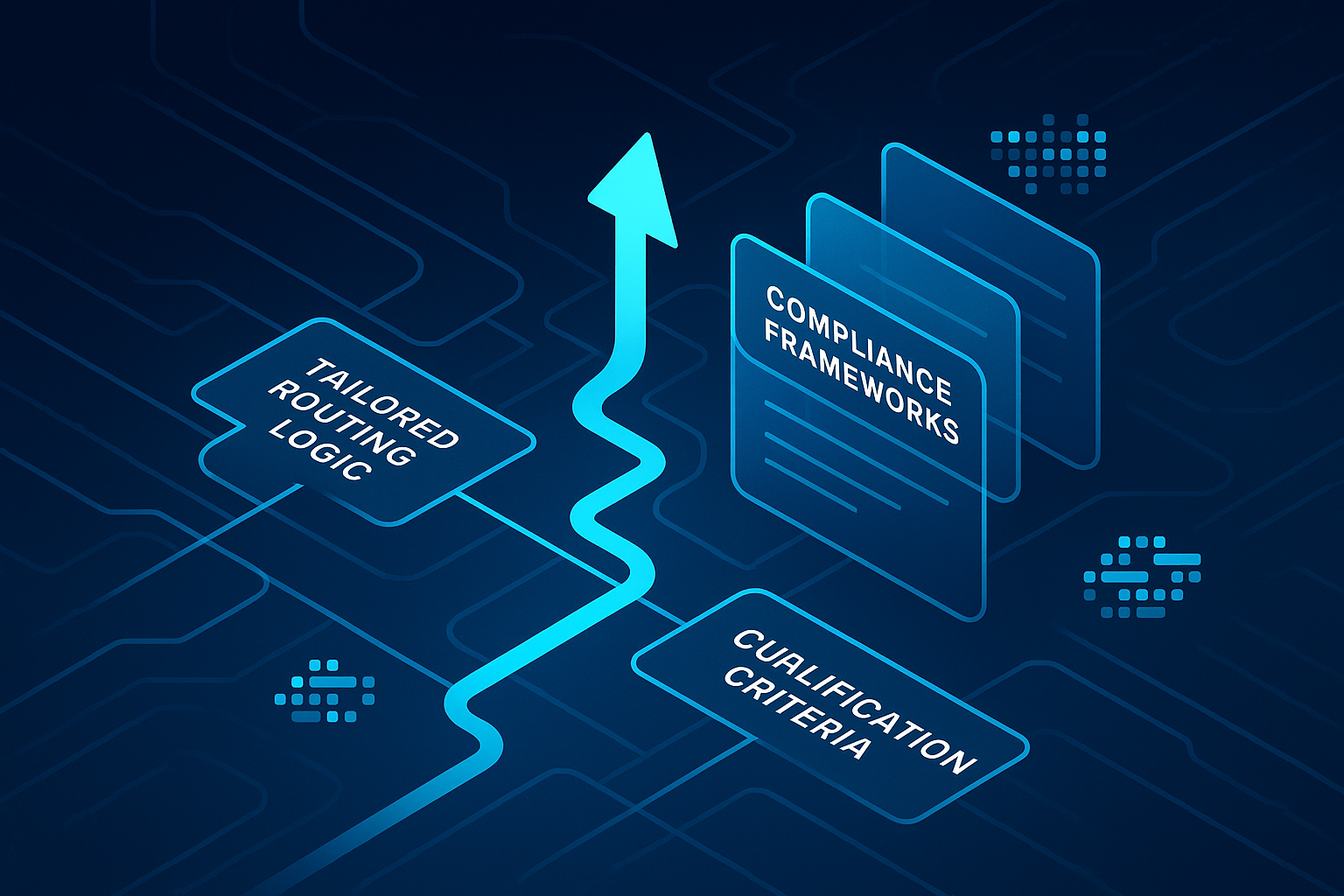
Each industry vertical requires tailored leads acquisition approaches that address specific compliance requirements, buyer behaviors, and conversion processes. Implementation success depends on understanding unique qualification criteria and routing logic that optimize for industry-specific outcomes.
These roadmaps provide actionable frameworks for deploying AI-powered acquisition systems that integrate with existing workflows while delivering measurable improvements in conversion rates and operational efficiency.
Real Estate: Property Matching and Agent Routing
AI-powered property matching bots qualify prospects based on budget, location preferences, and timeline urgency before routing to specialized agents. Automated CRM integration ensures immediate follow-up while maintaining compliance with regional privacy regulations and MLS requirements.
Success metrics include viewing conversion rates (target: 35-45%), property match accuracy (target: 80%+), and response time improvement (target: under 5 minutes for urgent leads). Implementation typically shows ROI within 60 days through improved agent productivity and higher closing rates.
Recruitment: Automated Candidate Screening and Interview Scheduling
Automated candidate scoring systems parse CVs for skills matching, experience relevance, and salary expectations before routing qualified prospects to specialized recruiters. ATS integration maintains candidate relationship continuity while reducing manual screening time by 70%.
Key metrics include time-to-hire reduction (target: 25% improvement), candidate match rate (target: 85%+), and interview show-rate optimization (target: 90%+). Recruitment firms typically achieve ROI within 45 days through improved placement velocity and reduced administrative overhead.
Fundraising: Personalized Investor Sequences and Follow-up Management
AI-driven investor persona prioritization identifies prospects based on portfolio alignment, funding stage preferences, and geographic focus. Automated outreach sequences maintain compliant communication cadences while tracking engagement signals for optimal timing.
Success indicators include meeting conversion rates (target: 12-18%), donor response rates (target: 25%+), and funds raised per campaign cycle. Implementation delivers measurable results within 90 days through systematic prospect nurturing and relationship management.
Hospitality: Guest Segmentation and Revenue Optimization
Reservation inquiry validation systems assess booking probability and revenue potential before routing to appropriate service levels. AI-powered upselling automation identifies opportunities for room upgrades, dining reservations, and ancillary services based on guest preferences and booking patterns.
Performance metrics focus on guest satisfaction scores (target: 4.5+ stars), no-show reduction (target: 15% improvement), and revenue per guest increases (target: 20%+ uplift). Staff productivity gains typically offset implementation costs within 30 days.
Key Metrics and Measurement Framework
Effective leads acquisition measurement focuses on conversion quality and revenue impact rather than vanity metrics. Industry-specific KPIs reveal optimization opportunities while demonstrating ROI to stakeholders across real estate, recruitment, fundraising, and hospitality sectors.
Attribution accuracy and lifecycle tracking provide actionable insights for budget allocation and process refinement, enabling data-driven decisions that compound acquisition effectiveness over time.
| Industry | Primary Conversion Metric | Quality Indicator | Efficiency Measure | Revenue Impact |
|---|---|---|---|---|
| Real Estate | Lead-to-viewing rate (35-45%) | Viewing-to-offer ratio (25%+) | Response time (under 5 min) | Average commission per lead |
| Recruitment | Candidate-to-interview rate (40%+) | Interview-to-placement ratio (30%+) | Time-to-hire reduction (25%) | Placement fee per qualified lead |
| Fundraising | Prospect-to-meeting rate (15%+) | Meeting-to-investment ratio (20%+) | Follow-up response time (24 hrs) | Average investment per prospect |
| Hospitality | Inquiry-to-booking rate (30%+) | Guest satisfaction score (4.5+ stars) | No-show reduction (15% improvement) | Revenue per guest increase (20%+) |
Cost per qualified lead varies significantly by source and industry, making attribution tracking essential for budget optimization. Real estate agencies often discover referral leads cost 60% less to acquire than paid search leads while converting at higher rates, justifying increased relationship marketing investment.
Lifecycle value measurement connects acquisition costs to long-term revenue potential, revealing that hospitality businesses benefit more from acquiring repeat corporate clients than one-time leisure travelers, despite higher initial acquisition expenses. For more insights on how SMEs can successfully adopt AI for lead acquisition, see this blog.
Common Pitfalls and Strategic Solutions
Most lead acquisition failures stem from prioritizing volume over quality, inadequate compliance frameworks, or poor CRM integration that creates data silos. These systematic issues compound over time, reducing conversion rates while increasing operational costs.
Proactive solutions address root causes through automated filtering, audit-ready documentation, and seamless workflow integration that maintains data integrity across all touchpoints.
Eliminating Low-Quality Leads Through Intelligent Filtering
Automated validation prevents junk leads from consuming sales resources by verifying contact information, assessing engagement signals, and scoring intent probability before routing. Following up leads in real-time reduces wasted effort by up to 80%, while significantly improving team morale and productivity.
Progressive qualification uses multi-step verification to separate genuine prospects from form spam, tire-kickers, and competitors conducting research. This approach maintains lead flow while dramatically improving conversion rates. For a deeper dive into the economic impact of AI-driven lead acquisition, refer to this NBER working paper.
Ensuring Compliance and Audit-Ready Documentation
Systematic consent logging and communication tracking protect against regulatory penalties while building prospect trust through transparent data handling. Automated compliance checks flag potential violations before they occur, maintaining clean audit trails.
Industry-specific regulations require tailored approaches: real estate lead handling differs from healthcare fundraising or hospitality guest data management. AI systems adapt compliance protocols to relevant jurisdictional requirements automatically.
Seamless CRM Integration and Data Consistency
API-driven integration maintains data synchronization between lead sources, qualification systems, and CRM platforms without manual data entry. This eliminates duplicate records, ensures follow-up continuity, and provides complete prospect visibility.
Workflow automation triggers appropriate actions based on lead scores, source attribution, and qualification status, ensuring no prospects fall through gaps while maintaining personalized engagement sequences.
Next Steps: Building Sustainable Lead Acquisition Advantage
Successful leads acquisition transformation requires systematic implementation that prioritizes quick wins while building long-term competitive advantages. Industry-specific AI automation delivers measurable improvements within 30-60 days when properly integrated with existing workflows.
Vynta's specialized approach addresses unique challenges across real estate, recruitment, fundraising, and hospitality sectors through purpose-built automation that augments human expertise rather than replacing relationship-building capabilities.
Implementation Priority Framework
Week 1-2: Audit current lead sources and qualification processes
Week 3-4: Deploy automated validation and basic scoring
Week 5-8: Integrate C
Frequently Asked Questions
What are lead acquisitions?
Lead acquisitions refer to the process of identifying and capturing potential customers or clients who have shown interest in a product or service. In business contexts like real estate, recruitment, fundraising, and hospitality, acquiring leads means gathering qualified prospects that can be nurtured into paying customers, candidates, donors, or guests, thereby driving measurable revenue growth.
What is the role of lead acquisition?
The role of lead acquisition is to build a pipeline of qualified prospects that fuel business growth by enabling targeted engagement and conversion efforts. Effective lead acquisition ensures a steady flow of potential clients or customers, allowing organizations to optimize sales, recruitment, fundraising, or guest service processes while improving ROI and operational efficiency.
How to acquire a lead?
To acquire a lead, businesses typically leverage strategies such as targeted advertising, content marketing, referral programs, or direct outreach tailored to their industry. For example, a boutique hotel might use personalized email campaigns and online reservation incentives, while a recruitment agency could implement AI-powered candidate sourcing to attract qualified talent, ensuring leads are relevant and ready for conversion.
What is the cost of acquiring a lead?
The cost of acquiring a lead varies widely depending on the industry, channel, and quality of the lead, often influenced by factors like advertising spend, technology investments, and labor costs. In mid-market SMEs, controlling lead acquisition cost is critical to maintaining profitability, as overspending on low-quality leads can dilute ROI, while strategic investment in targeted acquisition methods can enhance conversion rates and revenue per lead.
What is lead acquisition cost?
Lead acquisition cost (LAC) measures the total expense involved in generating a single qualified lead, encompassing marketing, sales efforts, technology, and overhead. This metric is essential for businesses to evaluate the efficiency of their lead generation strategies and ensure that the cost aligns with the expected revenue or value each lead can deliver across sectors like real estate, recruitment, fundraising, and hospitality.
What are the three types of leads?
The three primary types of leads are cold, warm, and hot leads. Cold leads have shown minimal or no prior engagement and require considerable nurturing; warm leads have demonstrated some interest or interaction, indicating a higher likelihood of conversion; hot leads are highly engaged and ready to make a purchase decision or commitment, allowing businesses to prioritize resources and tailor communication effectively.
About The Author
Anas Moujahid is the chief contributing writer & Operations Director for the Vynta Blog, where he turns cutting-edge AI automation into measurable business outcomes for mid-market companies.
Vynta designs enterprise-grade AI agents that augment rather than replace people, freeing teams to focus on higher-value work while the bots handle the busywork.
We specialise in four service-heavy verticals where AI can move the revenue needle fast: real estate, recruitment, fundraising and hospitality.
Anas started his career architecting AI and automation systems; today he leads operations at Vynta, making sure every deployment lands real-world ROI, whether that’s more booked viewings for estate agents, faster placements for recruiters, warmer investor pipelines for fundraisers or happier guests for hotels and restaurants.
Vynta delivers results by:
- Building industry-specific agents pre-trained on real-world workflows, no generic chatbots here.
- Integrating seamlessly with existing CRMs, ATSs, PMSs and fundraising platforms, zero rip-and-replace.
- Measuring success in business KPIs (lead-to-close rates, time-to-hire, donor retention, RevPAR) not vanity metrics.
- Providing transparent implementation plans so clients know exactly what to expect, when and why.
- Pairing every AI agent with human-in-the-loop controls to keep quality, compliance and brand voice on point.
Since launch, Vynta has helped agencies slash lead qualification time by up to 70 %, recruitment firms cut screening hours in half, fundraising teams triple investor touchpoints and hospitality brands lift guest satisfaction scores by double digits, all while keeping human expertise firmly in the loop.
Anas writes with the same ethos that drives Vynta: outcome-focused, jargon-free and grounded in real business value. Expect data-backed insights, practical implementation guides and a clear-eyed view of what AI can, and can’t, do for your organisation.