
Key Takeaways
- A quick 3-step exercise can help identify high-impact chatbot opportunities in under 30 minutes.
- Start by listing the top 10 recurring questions or tasks your team handles daily.
- Evaluate each task’s business impact by estimating time saved, revenue potential, and customer satisfaction improvements.
- Rank tasks based on frequency, impact, and suitability for automation to prioritize chatbot implementation.
Table of Contents
- Why Chatbot Design Now Means Business Outcomes, Not Just “Nice UX”
- Chatbot Design Fundamentals: From Interface to Business Impact
- Defining Purpose, Use Cases & Scope: Designing for ROI, Not Novelty
- Rule‑Based vs AI‑Driven Chatbots: Choosing the Right Engine for Your Design
- User‑Centred Chatbot Design: Mapping Intents, Journeys & Jobs‑to‑Be‑Done
Why Chatbot Design Now Means Business Outcomes, Not Just “Nice UX”
The chatbot explosion of 2024-2025 has produced thousands of AI assistants that can chat brilliantly—yet fail to move a single business metric. While companies rush to deploy conversational AI, most treat chatbot design as an afterthought, focusing on clever responses rather than measurable ROI.
Here’s the reality: effective chatbot design isn’t about creating the most human-like conversation. It’s about engineering specific business outcomes—higher conversion rates, faster response times, increased customer satisfaction scores. The difference between a chatbot that impresses visitors and one that drives revenue lies in intentional design that connects every conversation turn to a measurable business goal.
At Vynta AI, we’ve seen this distinction play out across our four core verticals. In real estate, well-designed chatbots don’t just answer property questions—they qualify leads and book viewings. In recruitment, they don’t just field candidate queries—they screen for fit and schedule interviews. In fundraising, they identify serious investors and secure meetings. In hospitality, they handle bookings while driving upsell opportunities.
Chatbot Design Fundamentals: From Interface to Business Impact
What Is Chatbot Design?
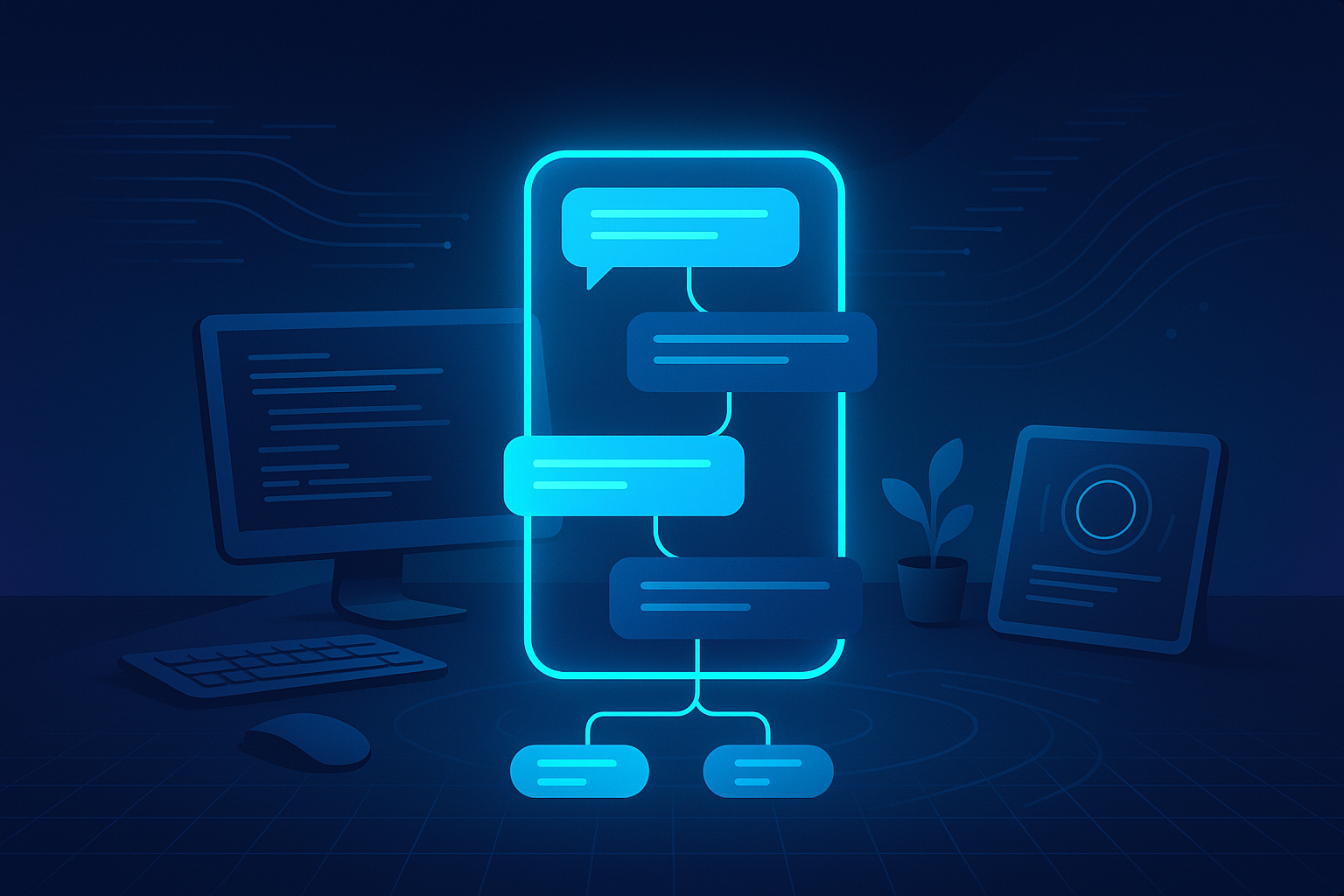
Chatbot design is the systematic process of creating automated conversation experiences that solve real business problems. Unlike traditional web design that focuses on pages and forms, chatbot design orchestrates dynamic, multi-turn interactions that adapt based on user responses and business context.
Effective chatbot design blends five critical disciplines: conversation design (mapping dialogue flows), user experience design (interface and interaction patterns), artificial intelligence behavior (how the bot understands and responds), system integration (connecting to CRMs, databases, and business tools), and business process design (aligning conversations with operational workflows).
The key distinction is between “designing a bot” versus “adding a chat widget.” A chat widget is an interface element. A designed chatbot is a complete business system that captures, qualifies, and routes opportunities while maintaining consistent brand experience across every interaction.
Core Components of a Well-Designed Chatbot
Every business-grade chatbot operates across four interconnected layers. The conversation layer defines intents (what users want to accomplish), entities (key data points to extract), and dialogue logic (how conversations progress). The interface layer encompasses chat windows, message bubbles, input fields, quick-reply buttons, and media handling.
The intelligence layer determines how your bot processes user input—through rule-based decision trees, natural language processing, or large language models. Finally, the integration layer connects conversations to your business systems: CRMs for lead capture, ATS platforms for candidate screening, property management systems for booking, or fundraising databases for investor tracking.
These layers must work in harmony. A sophisticated AI engine means nothing if the conversation flows confuse users, just as elegant interface design fails without proper system integrations to complete business transactions.
Conversational UX vs Traditional UX
Traditional web design guides users through pages, forms, and menus in predictable sequences. Conversational UX handles unpredictable, multi-turn dialogues where users can change topics, ask follow-up questions, or provide incomplete information.
Conversational patterns excel when dealing with complex, conditional questions—like property searches with multiple criteria, candidate screening with branching qualifications, or fundraising discussions that adapt based on investor type. Traditional forms work better for simple, linear data collection with 1-2 fields requiring high precision.
| Scenario | Best Approach | Why |
|---|---|---|
| Property search with budget, location, size preferences | Conversational | Complex criteria with natural follow-ups |
| Email newsletter signup | Traditional form | Two fields, no branching logic needed |
| Candidate pre-screening for role fit | Conversational | Conditional questions based on experience level |
| Event registration with fixed details | Traditional form | Straightforward data capture |
The One Question to Start With: “What Business Metric Will This Bot Move?”
Before designing a single conversation flow, define exactly which business metrics your chatbot will impact. This clarity determines every design decision from greeting messages to integration requirements.
Real estate agencies should focus on qualified appointments per week and response time to new leads. Recruitment firms need to track CVs screened per hour and time-to-shortlist qualified candidates. Fundraising organizations benefit from measuring investor meetings booked monthly and follow-up completion rates. Hospitality businesses can target RevPAR uplift, upsell conversion rates, and no-show reduction.
Define 1-2 primary KPIs and 2-3 supporting UX metrics before drawing your first conversation flow. This metric-first approach ensures every design element serves a business purpose rather than just creating impressive demonstrations.
Defining Purpose, Use Cases & Scope: Designing for ROI, Not Novelty
How to Define Clear Goals and Use Cases (In Under 30 Minutes)
The fastest way to identify winning chatbot opportunities is through a structured 3-step exercise that takes less than 30 minutes. First, list the top 10 recurring questions or tasks your team handles daily from support tickets, sales inquiries, or operational requests. Second, map each item to its business impact by estimating time saved per interaction, potential revenue influence, and customer satisfaction improvement. Third, rank everything by frequency × impact × automation-fit to identify your highest-value targets.
For example, a hospitality business might discover that check-in FAQs, reservation modifications, and restaurant upsell offers represent 60% of front desk interactions while directly impacting RevPAR and guest satisfaction scores. A recruitment agency could find that initial candidate screening for basic qualifications consumes 40% of consultant time but follows predictable patterns perfect for automation.
Scope Your First Version: Do Less to Win More
Your first chatbot version should master 3-5 tightly scoped intents rather than attempting 50 mediocre ones. This focused approach delivers measurable ROI faster while building user confidence in your bot’s capabilities. Start with high-frequency, low-complexity interactions that follow predictable patterns.
Winning first-version scopes by vertical include: real estate agents focusing on buyer qualification plus viewing bookings; recruitment firms handling pre-screening for 3-4 knockout criteria; fundraising organizations qualifying investor fit and scheduling intro calls; hospitality businesses managing availability checks, booking changes, and their top 3 upsells. If any single intent regularly requires more than 10 conversation turns, split it into multiple focused flows or simplify the underlying process.
Where Chatbots Should *Not* Be Your First Line
Effective chatbot design requires knowing when to step back. Highly emotional situations like cancellations due to emergencies, serious complaints, or sensitive personal circumstances need human empathy from the start. Similarly, edge cases requiring complex judgment calls—unique contract exceptions, regulatory advice, or high-stakes negotiations—should trigger immediate human handoff rather than frustrating users with inadequate bot responses.
Design early human-handoff triggers for these high-risk intents. For instance, hospitality chatbots should escalate immediately when guests mention words like “emergency,” “complaint,” or “refund,” while recruitment bots should pass complex visa or accommodation requests directly to consultants who understand the legal nuances.
Balancing Short-Term Wins with a 12–18 Month Vision
Smart chatbot roadmapping delivers quick wins while building toward sophisticated automation. Months 1-3 should focus on FAQs and simple transactions that immediately reduce team workload. Months 4-9 enable deeper integrations and multi-step workflows that drive revenue impact. Months 10-18 introduce proactive and personalized experiences that differentiate your service quality.
This phased approach lets you prove ROI early while continuously expanding capabilities. A boutique hotel might start with basic availability queries, then add booking modifications and upsell offers, eventually reaching proactive guest experience management and personalized recommendations based on stay history.
Rule‑Based vs AI‑Driven Chatbots: Choosing the Right Engine for Your Design
Two Main Archetypes (Plus the Hybrid Reality)
Modern chatbots fall into three main categories, each requiring different design approaches. Rule-based systems use decision trees, buttons, and structured flows to guide users through predetermined paths. AI/NLP-powered bots understand free text input, detect user intents, and extract entities from natural language. LLM-powered systems generate contextual responses while grounding answers in your knowledge base, offering the most flexible but complex option.
Most successful business chatbots today use hybrid architectures—combining rule-based flows for transactional tasks with AI capabilities for natural language understanding and LLM components for complex queries. This approach maximizes control over critical business processes while providing conversational flexibility where it adds value.
Design Differences You Must Account For
Your design methodology changes significantly based on your chosen architecture. Rule-based systems require explicit step-by-step flows with strict validation and clear menu options at each decision point. AI-driven systems need looser conversation flows with emphasis on intent recognition, entity extraction, and clarification dialogues when the bot isn’t confident about user requests.
| Aspect | Rule-Based | AI/NLP-Driven | LLM-Hybrid |
|---|---|---|---|
| Flow Design | Rigid decision trees | Intent-based branching | Contextual responses with guardrails |
| User Input | Buttons and quick replies | Free text with structured fallbacks | Natural conversation with validation |
| Maintenance | Manual flow updates | Training data refinement | Knowledge base management |
| Predictability | Complete control | High with good training | Requires careful boundaries |
| Setup Complexity | Low | Medium | High |
When to Use Which (With Vertical Examples)
| Design Aspect | Rule-Based | AI/NLP-Driven | LLM-Hybrid |
|---|---|---|---|
| Flow Structure | Linear, menu-driven paths | Intent-based branching | Dynamic, context-aware responses |
| User Input | Buttons, quick replies, forms | Natural language + structured options | Open-ended conversation |
| Error Handling | Clear fallback menus | Clarification questions | Contextual rephrasing |
| Maintenance | Update decision trees | Retrain intent models | Refine knowledge base |
| Control Level | High predictability | Moderate with guardrails | Requires careful boundaries |
LLM-powered systems require the most sophisticated design approach, with emphasis on knowledge boundaries, source attribution, and graceful degradation when the model encounters unfamiliar territory. Always include “check with human” options and clearly show information sources to maintain user trust.
Real estate businesses benefit from rule-based systems for simple lead capture forms but need AI capabilities for property matching based on complex criteria like lifestyle preferences, commute requirements, and budget flexibility. The structured nature of property data makes AI-driven filtering highly effective while keeping transaction flows predictable.
Recruitment scenarios split naturally: use AI for profile screening where candidates describe experience in their own words, but rely on rule-based flows for interview slot selection and availability booking. Fundraising organizations should deploy AI for investor Q&A sessions while using structured approaches for compliance-heavy data capture and due diligence document requests.
Hospitality businesses see the biggest wins from hybrid approaches—AI handles open-ended concierge questions and guest preferences, while rule-based systems manage booking modifications and payment processing where accuracy is non-negotiable. This combination delivers personalized service without sacrificing operational reliability.
For a deeper dive into the economic impact of generative AI, see the economic potential of generative AI.
Avoiding LLM Pitfalls in Design
LLM-powered chatbots require specific design patterns to prevent hallucinations and maintain accuracy. Implement retrieval-augmented design by grounding all responses in your verified knowledge base rather than allowing pure generative answers. Always display source information and offer explicit “verify with human” options for high-stakes decisions.
Set clear answer boundaries by defining topics your bot can and cannot address. Design fallback responses that redirect out-of-scope questions rather than attempting creative but potentially incorrect answers. This approach maintains user trust while leveraging LLM capabilities where they add genuine value.
User‑Centred Chatbot Design: Mapping Intents, Journeys & Jobs‑to‑Be‑Done
Understanding Intents, Entities & Context in Business Language
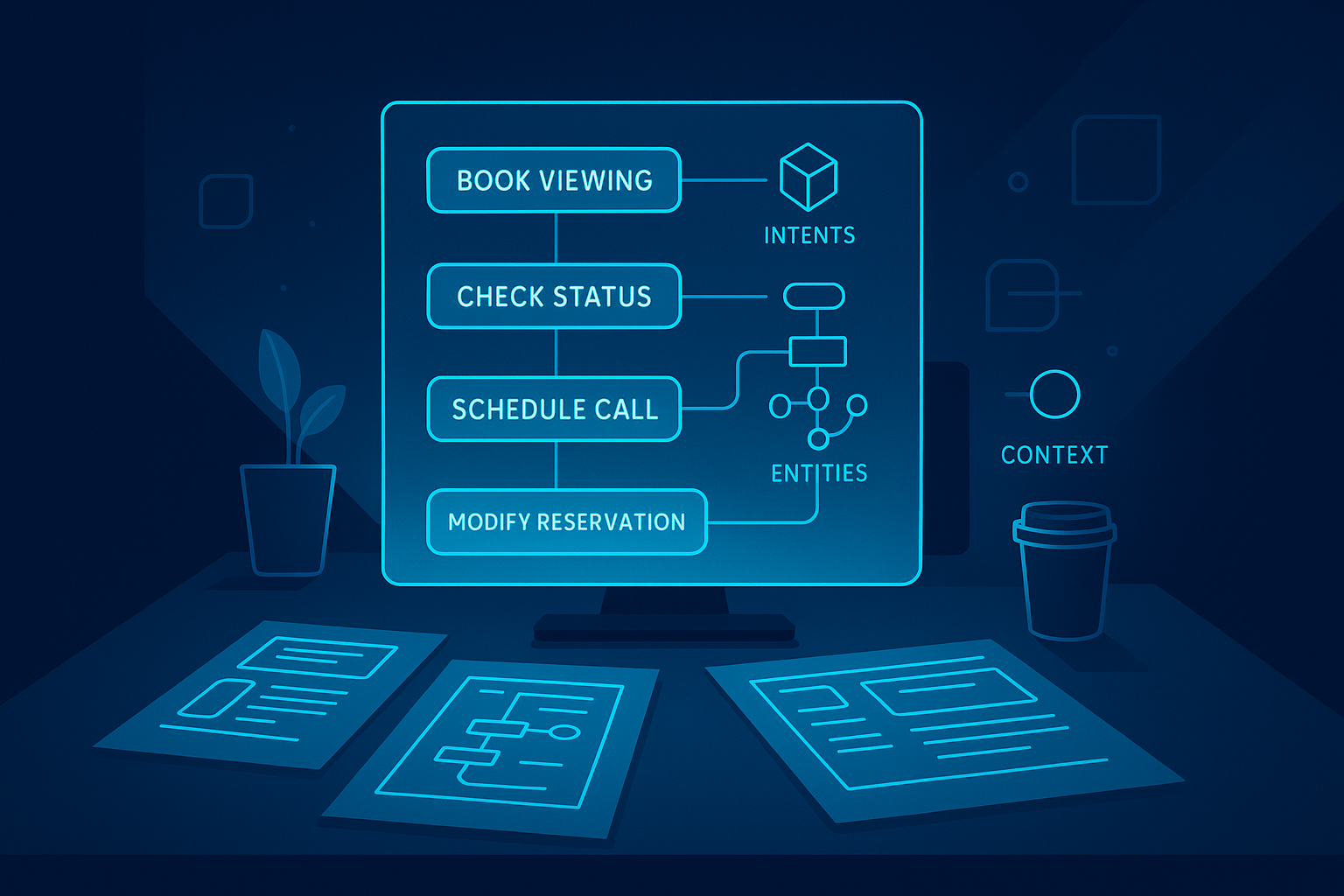
Intents represent what users want to accomplish—”book a viewing” in real estate, “check application status” in recruitment, “schedule investor call” in fundraising, or “modify reservation” in hospitality. Entities are the specific details within those intents: property type, candidate name, investment amount, or reservation date. Context encompasses everything else: user history, current conversation state, time of day, and relevant business data.
Quick Definition: Intent = the goal, Entity = the details, Context = everything that makes the response relevant and personal.
How to Research User Needs for a Chatbot (in 7 Days)
Effective chatbot design starts with data-driven user research that takes just one week. Review 200-300 recent support tickets, emails, or chat logs to identify recurring themes and cluster them by topic and frequency. Interview 3-5 frontline staff from each relevant function to understand pain points, edge cases, and seasonal variations in user needs.
This process typically reveals 20 core intents that represent 70-80% of user interactions. For example, a boutique hotel might discover that room availability, booking changes, local recommendations, dining reservations, and checkout questions dominate guest communications, while a recruitment firm finds that application status, interview scheduling, role requirements, salary discussions, and feedback requests drive most candidate interactions.
For a foundational overview of chatbot technology, see the Wikipedia article on chatbots.
Mapping User Journeys into Conversational Flows
Converting linear user journeys into conversational flows requires breaking down each step into natural dialogue turns while maintaining logical progression. A typical journey follows search → information gathering → decision → action → confirmation, but conversations allow for back-and-forth clarification that can improve outcomes.
Consider a boutique hotel booking change scenario: Guest states request → Bot confirms booking details → Guest specifies changes → Bot checks availability → Bot presents options → Guest selects preference → Bot processes change → Bot confirms new details. This 7-turn flow feels natural while capturing all necessary information and providing clear confirmation at each step.
Keep critical paths under 6-8 turns wherever possible. Longer conversations increase abandonment risk and user frustration, especially on mobile devices where attention spans are shorter and typing is more cumbersome.
For more insights on aligning AI with user needs, you may find this HBR article on designing AI that aligns with user needs helpful.
Frequently Asked Questions
What are the key steps to identify high-impact chatbot opportunities quickly?
Start by listing the top 10 recurring questions or tasks your team handles daily. Then evaluate each task’s business impact by estimating time saved, revenue potential, and customer satisfaction improvements. Finally, rank these tasks based on frequency, impact, and suitability for automation to prioritize chatbot implementation effectively.
How does effective chatbot design contribute to measurable business outcomes beyond just user experience?
Effective chatbot design focuses on driving specific business metrics such as higher conversion rates, faster response times, and improved customer satisfaction scores. By aligning conversation flows with clear business goals, chatbots move beyond simply engaging users to actively generating revenue and operational efficiencies.
What are the fundamental components involved in designing a business-grade chatbot?
Designing a business-grade chatbot involves conversation flow architecture, user interface elements, AI behavior patterns, and system integrations. Together, these components create automated interactions that are dynamic, context-aware, and purpose-built to solve real business problems and deliver measurable outcomes.
How do rule-based chatbots differ from AI-driven chatbots, and how should I choose the right type for my business?
Rule-based chatbots operate on predefined scripts and are best suited for straightforward, repetitive tasks with clear decision trees. AI-driven chatbots use natural language understanding to handle complex, varied interactions and learn over time. Choosing the right type depends on your business needs—opt for rule-based for simple automation and AI-driven when flexibility and scalability are priorities.
About The Author
Anas Moujahid is the chief contributing writer & Operations Director for the Vynta AI Blog, where he turns cutting-edge AI automation into measurable business outcomes for mid-market companies.
Vynta AI designs enterprise-grade AI agents that augment rather than replace people—freeing teams to focus on higher-value work while the bots handle the busywork.
We specialise in four service-heavy verticals where AI can move the revenue needle fast: real estate, recruitment, fundraising and hospitality.
Anas started his career architecting AI and automation systems; today he leads operations at Vynta AI, making sure every deployment lands real-world ROI—whether that’s more booked viewings for estate agents, faster placements for recruiters, warmer investor pipelines for fundraisers or happier guests for hotels and restaurants.
Vynta AI delivers results by:
- Building industry-specific agents pre-trained on real-world workflows—no generic chatbots here.
- Integrating seamlessly with existing CRMs, ATSs, PMSs and fundraising platforms—zero rip-and-replace.
- Measuring success in business KPIs (lead-to-close rates, time-to-hire, donor retention, RevPAR) not vanity metrics.
- Providing transparent implementation plans so clients know exactly what to expect, when and why.
- Pairing every AI agent with human-in-the-loop controls to keep quality, compliance and brand voice on point.
Since launch, Vynta AI has helped agencies slash lead qualification time by up to 70 %, recruitment firms cut screening hours in half, fundraising teams triple investor touchpoints and hospitality brands lift guest satisfaction scores by double digits—all while keeping human expertise firmly in the loop.
Anas writes with the same ethos that drives Vynta AI: outcome-focused, jargon-free and grounded in real business value. Expect data-backed insights, practical implementation guides and a clear-eyed view of what AI can—and can’t—do for your organisation.